I'm Going to the Hospital
Help your child walk into the hospital brave, not terrified
The fear of the unknown is the hardest part. This personalized social story names your child and walks them through the visit, step by step, so it feels familiar. Gentle for ages 3 to 5. Start free in minutes.
From$34.99 USD
Free to start. No payment to see your child in the story.
- 32 pages, hardcover
- 5.9 × 5.9 in
- Ages 3-5
- Premium, thick pages
- Free standard shipping included
- Printed & delivered in 2-3 weeks (US)
Start with the story’s own hero or pick from our cast — then give them your child’s name.
A personalized social story that prepares toddlers for hospital visits — step by step, fear by fear.
That’s the story. The rest is how it becomes your child’s.
How personalization works
Who is this story about?

Keep the story’s own hero
The hero is already written and drawn for this book. Give them your child’s name if you like — that’s the whole edit.
Or swap in one of our cast
Eight characters to start from, and you rename whoever you pick.
- Luna

- Theo

- Mateo

- Sofia

- Amara

- Layla

- Mei

- Ravi

Or make your own
Describe them in a sentence, or add a photo to guide the likeness. Either way, entirely optional.
The characters are just the start.
Every part of this book is yours to change. Not a name dropped into a template — the whole thing is redrawn around the child you’re making it for.
- Every illustrationAll 32 pages are drawn fresh, not stamped with a face.
- The rooms and placesYour child's actual bedroom, your street, the places the story visits.
- The objects that recurThe specific blanket, the toy they won’t sleep without — carried page to page.
- Everyone else in itSiblings, grandparents, the dog. Named and drawn as themselves.
- The story itselfChange what happens, and the words on the page change with it.
- Or change nothingPick a hero and read it tonight. The rest is there when you want it.
What's Inside This Book
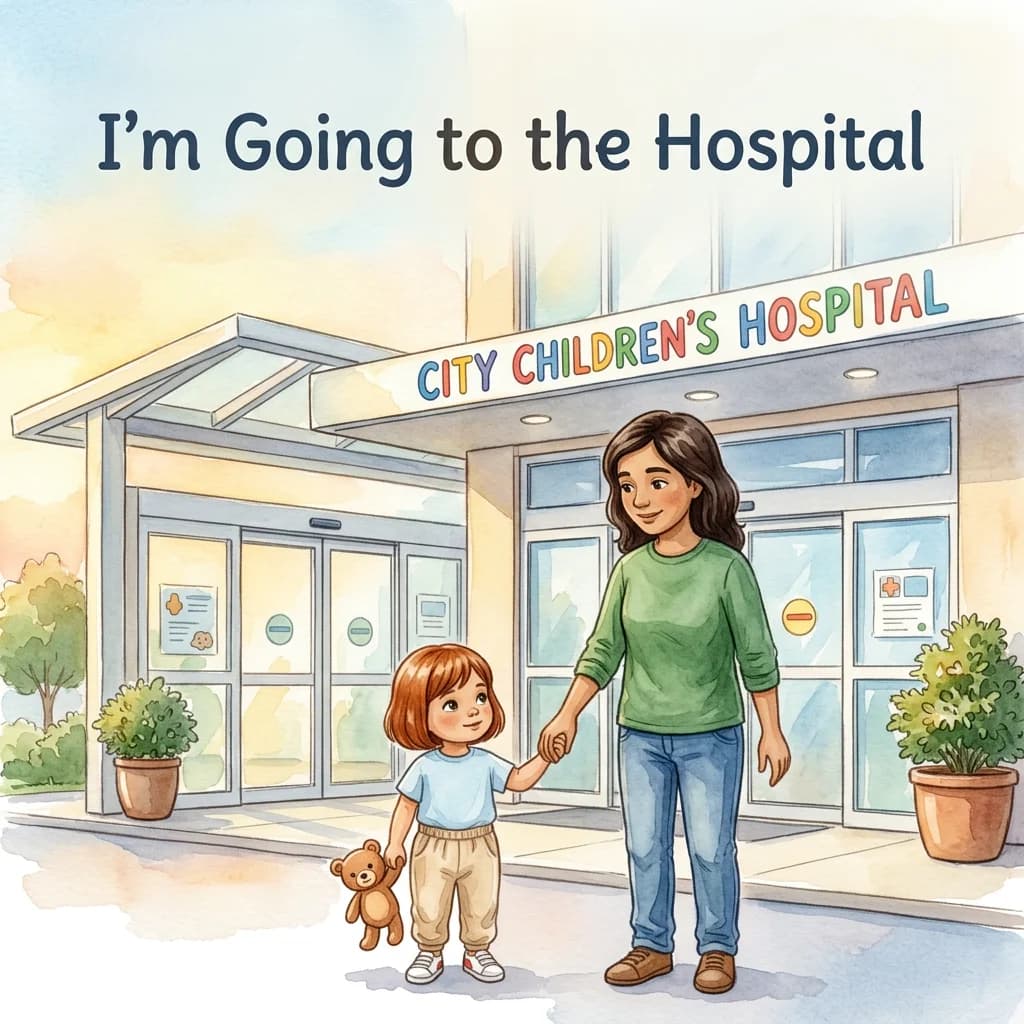
1 of 17 spreads
Every character, scene, and object in this book can be replaced with your own — your child's name, your family photos, your home, your school.
What you get
Free to start. No payment to see your child in the story.
Start free
- Free to start — no card needed
- See your child in the story in minutes
- Rename the hero and edit the story text
- Choose a ready-made character, or add a photo later
- Export a PDF of what you make
Your perfect keepsake
Hardcover book
- Full-color hardcover, 15×15cm
- Free standard shipping included
- Printed & delivered in about 2-3 weeks (US)
- Personalize names, story text & style
- Add your own photos once you are in the editor
Quick summary of I'm Going to the Hospital
This personalized social story guides preschoolers (ages 3-5) through a hospital visit step by step, addressing common fears like loud noises, new people, and unfamiliar equipment. It empowers children with knowledge and courage while strengthening family bonds during medical experiences.
This personalized children's book is a hospital social story for ages 3–5. It features a child character with the reader's name, plus a parent, doctor, nurse, and receptionist. It narrates each stage of a hospital visit to build familiarity and reduce anxiety before the appointment.
Key Takeaways
- Reduces pre-visit anxiety by walking children through each hospital step in sequence
- Names every staff member children will meet, turning strangers into familiar, friendly faces
- Builds emotional courage by framing shots and exams as brave, manageable moments
- Reinforces caregiver presence throughout, giving toddlers a constant anchor of safety
- Models good manners naturally by showing the child say thank you before leaving
Why This Book Works
Social stories — a technique developed by Carol Gray in 1991 — are one of the most evidence-backed tools for preparing young children for medical environments. By narrating an unfamiliar experience before it happens, children build a mental script that reduces the startle effect of new sights and procedures. A 2019 review in the Journal of Pediatric Nursing found that pre-procedural narrative preparation significantly lowered distress scores in children aged 3–6.
Personalization amplifies the effect dramatically. When a child hears their own name in the story, the brain's self-referential processing — centered in the medial prefrontal cortex — activates more deeply, strengthening memory and emotional identification with the character. This means your child doesn't just follow the story passively — they rehearse it as their own experience, arriving at the hospital with genuine familiarity.
The book also quietly models co-regulation, a strategy Dr. Dan Siegel describes as the foundation of emotional resilience in early childhood. Lines like "I can squeeze my grown-up's hand" give children a concrete coping action, not just reassurance. Research from the Child Mind Institute shows that named coping strategies — physical anchors especially — reduce procedural fear more effectively than verbal comfort alone.
Common Misconceptions
Reading a hospital book will make children more anxious beforehand.
Research consistently shows the opposite. Pre-procedural narrative preparation reduces distress. A 2019 Journal of Pediatric Nursing review found children with story preparation showed measurably lower anxiety than unprepared peers.
Toddlers are too young to benefit from social stories.
Carol Gray's social story framework has been validated for children as young as 3. Simple, sequential narratives match toddlers' cognitive stage and help them rehearse unfamiliar scenarios before they encounter them.
Just telling your child about the hospital is enough preparation.
Verbal explanation activates a different processing pathway than story narrative. Illustrated, personalized stories engage visual memory and self-referential thinking, giving children a richer, more durable mental rehearsal than a quick conversation.
How to Read This Book with Your Child
Best time to read: Read first 2–3 days before the appointment, then again the night before. Avoid the morning of the visit only — that timing can spike rather than soothe anxiety.
Read the book 2–3 days before the visit, not just the morning of. Tell your child, "This is a story about someone just like you going to the hospital." Keep your tone calm and matter-of-fact — children mirror caregiver emotion. If they ask questions, answer honestly and simply before turning the page.
Conversation Starters
- “Which person at the hospital do you think will be the kindest?”
- “What will you do if something feels a little scary or hurts for a moment?”
- “When we get home after the hospital, what treat or activity should we do together?”
Frequently Asked Questions
At what age can my child understand this hospital book?
This book is designed for preschoolers ages 3-5 years old. It uses simple language, visual storytelling, and familiar emotions to match early childhood understanding. Children under 3 may benefit from reading with an adult present.
Will this book help reduce my child's hospital anxiety?
Yes. This social story works by replacing fear of the unknown with factual, gentle explanations. Repeated readings before a hospital visit help children mentally prepare, ask questions, and feel more in control—proven effective for reducing procedural anxiety.
What hospital experiences does this book cover?
The story covers arrival at the hospital, meeting medical staff, common procedures, equipment sounds, separation from parents (when applicable), and the discharge process—addressing the most common sources of child anxiety.
Can I customize this book for my child's specific procedure?
This book provides a general hospital visit framework that applies to most situations. For highly specialized procedures, we recommend reading this first to build comfort, then talking with your child's medical team about procedure-specific details.
How many times should I read this before a hospital visit?
Reading 3-5 times over 1-2 weeks before the visit is ideal. Frequent, relaxed readings help normalize the experience. You can pause to answer questions, validate feelings, and reassure your child of your presence and support throughout.
Is this book appropriate for children with previous hospital trauma?
For children with past negative experiences, this gentle, empowering approach can help rebuild trust. However, consider reading with a child therapist or your pediatrician if your child shows significant trauma responses to medical situations.
Help your child walk into the hospital brave, not terrified
Free to start. No payment to see your child in the story.