My New Daycare Adventure
The starting daycare story, rewritten for your child
Every page is redrawn around the child you make it for. Keep the story’s own hero and give them your child’s name, or choose someone new — it takes a minute, and nothing is locked in.
From$34.99 USD
Free to start. No payment to see your child in the story.
- 32 pages, hardcover
- 5.9 × 5.9 in
- Ages 2-3
- Premium, thick pages
- Free standard shipping included
- Printed & delivered in 2-3 weeks (US)
Start with the story’s own hero or pick from our cast — then give them your child’s name.
A personalized first-daycare story that turns separation anxiety into excited anticipation for toddlers ages 2–3.
That’s the story. The rest is how it becomes your child’s.
How personalization works
Who is this story about?

Keep the story’s own hero
The hero is already written and drawn for this book. Give them your child’s name if you like — that’s the whole edit.
Or swap in one of our cast
Eight characters to start from, and you rename whoever you pick.
- Luna

- Theo

- Mateo

- Sofia

- Amara

- Layla

- Mei

- Ravi

Or make your own
Describe them in a sentence, or add a photo to guide the likeness. Either way, entirely optional.
The characters are just the start.
Every part of this book is yours to change. Not a name dropped into a template — the whole thing is redrawn around the child you’re making it for.
- Every illustrationAll 32 pages are drawn fresh, not stamped with a face.
- The rooms and placesYour child's actual bedroom, your street, the places the story visits.
- The objects that recurThe specific blanket, the toy they won’t sleep without — carried page to page.
- Everyone else in itSiblings, grandparents, the dog. Named and drawn as themselves.
- The story itselfChange what happens, and the words on the page change with it.
- Or change nothingPick a hero and read it tonight. The rest is there when you want it.
What's Inside This Book
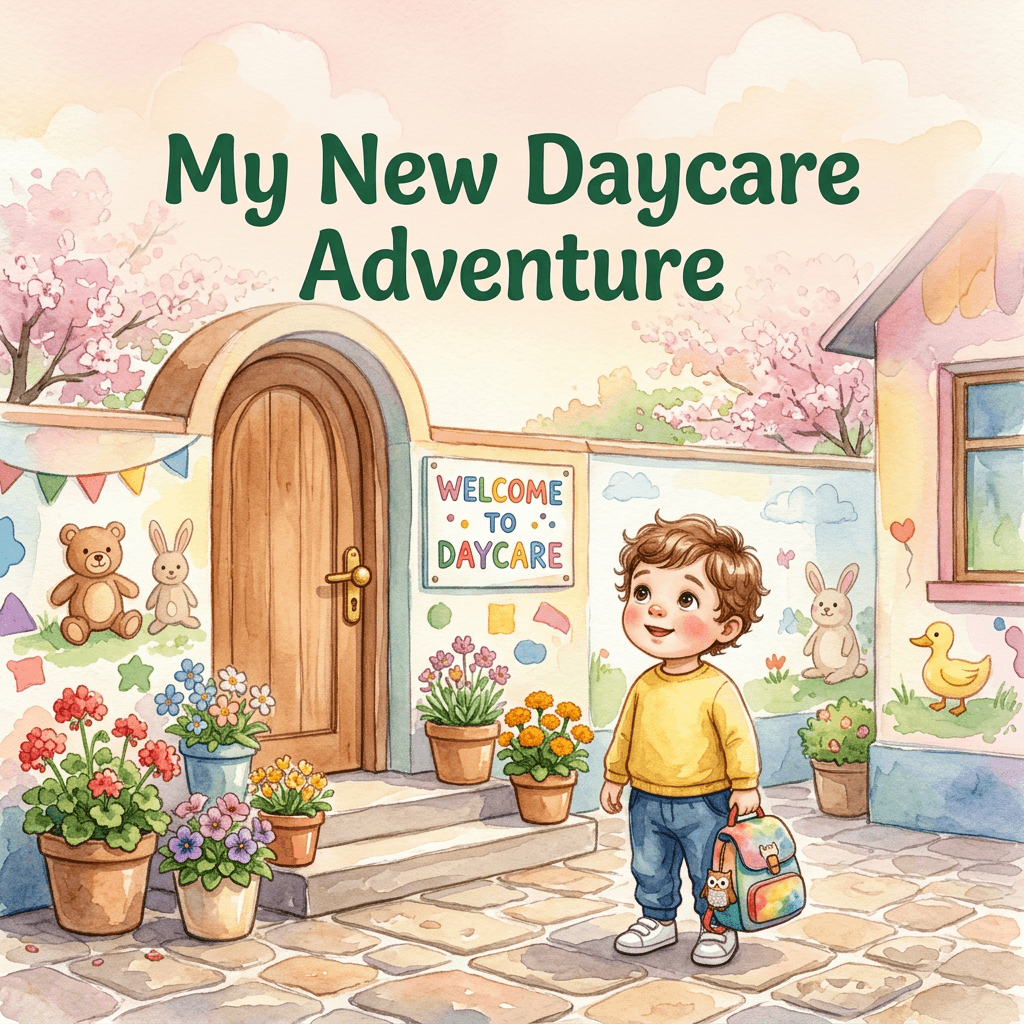
1 of 17 spreads
Every character, scene, and object in this book can be replaced with your own — your child's name, your family photos, your home, your school.
What you get
Free to start. No payment to see your child in the story.
Start free
- Free to start — no card needed
- See your child in the story in minutes
- Rename the hero and edit the story text
- Choose a ready-made character, or add a photo later
- Export a PDF of what you make
Your perfect keepsake
Hardcover book
- Full-color hardcover, 15×15cm
- Free standard shipping included
- Printed & delivered in about 2-3 weeks (US)
- Personalize names, story text & style
- Add your own photos once you are in the editor
Quick summary of My New Daycare Adventure
My New Daycare Adventure is a personalized story that transforms daycare anxiety into anticipation by featuring your child as the main character experiencing a positive first day with supportive caregivers and new friends, making the transition feel safe and exciting.
This personalized children's book follows Milo, ages 2–3, through his very first day at daycare. He meets kind teacher Miss Sunny, befriends Zoe, and enjoys snacks and storytime. Parents can personalize the child's name, making the adventure feel genuinely their own.
Key Takeaways
- Builds separation confidence through a warm reunion scene that reassures toddlers Mama always returns
- Normalizes new-environment anxiety by showing Milo's hesitation dissolving naturally into joyful play
- Models friendship-making with a low-pressure invitation scene children can mentally rehearse
- Reinforces daily daycare rhythms — snack, story, outdoor play — so routines feel familiar before day one
- Celebrates small bravery, helping toddlers internalize the identity of being 'brave enough' to try
Why This Book Works
Bibliotherapy works because children rehearse emotional experiences through story before facing them in real life. Dr. Lawrence Cohen, author of Playful Parenting, notes that narrative play reduces anticipatory fear by giving children a mental script. Milo's journey — from the doorway to the playground — gives toddlers a concrete sequence to expect, which child development research consistently links to reduced first-day distress.
The reunion scene on page 25 is developmentally precise for 2–3 year olds navigating Bowlby's attachment theory. Secure attachment is reinforced when children see the caregiver leaving AND returning within the same narrative arc. A 2018 review in Early Childhood Education Journal found that books depicting predictable reunions significantly lowered cortisol responses in toddlers during drop-off transitions compared to control groups.
Personalization amplifies emotional engagement — hearing their own name activates a child's self-referential processing in ways a generic character cannot. Research from the University of Wisconsin's literacy lab found personalized books increased story recall by 27% in children ages 2–4. When Milo shares the child's name, the daycare adventure stops being someone else's story and becomes a rehearsal for their own brave first step.
Common Misconceptions
Toddlers adjust faster if parents do a quick, sneaky goodbye.
Child development psychologist Dr. Tovah Klein advises against 'stealth departures.' Consistent, brief goodbye rituals build trust and actually shorten distress duration compared to disappearing without warning.
Crying at drop-off means the child isn't ready for daycare.
Tears at separation are developmentally normal through age 3 and signal healthy attachment, not unreadiness. Most children calm within minutes of the caregiver leaving, according to Zero to Three's 2020 guidance.
Reading one book once won't make any real difference.
Repeated readings compound impact. A 2019 study in Journal of Child Psychology found that re-reading the same transitional story three times before an event reduced anxiety markers more than a single exposure.
How to Read This Book with Your Child
Best time to read: Read it every night for the 3–5 days before daycare starts, then again on the morning of the first drop-off.
Start 3–5 days before daycare begins, not the night before. Show your child the book cover and say, 'This is a story about someone going somewhere new — just like you.' Ask what they think is inside the big daycare door to activate curiosity before the first page turns.
Conversation Starters
- “What do you think Milo felt when he first walked through the daycare door?”
- “If you could bring one toy to daycare like Milo, what would you choose?”
- “Who would you most want to sit next to at snack time — and why?”
Frequently Asked Questions
What age is this book appropriate for?
My New Daycare Adventure is designed for toddlers ages 2-3, the typical age when children begin daycare. The simple narrative, bright illustrations, and short sentences match toddler attention spans and comprehension levels.
How does personalization help with separation anxiety?
When your child sees themselves as the main character experiencing daycare positively, they feel personally connected to the story. This helps normalize the experience and reduces anxiety by showing their own name and face successfully navigating the new environment.
When should I start reading this book to my toddler?
Begin reading 2-3 weeks before daycare starts. Repeat readings build familiarity and confidence. Continue reading during the first weeks of daycare to reinforce that going to daycare is normal, safe, and something to look forward to.
Does this book address the parent return?
Yes, the story emphasizes that parents always come back to pick up their child at the end of the day, directly addressing the core fear in separation anxiety and providing reassurance.
What topics does the book cover about daycare?
The story covers arrival, meeting teachers, playing with new friends, snack time, outdoor play, and parent pickup. It normalizes daily routines and shows positive interactions with caregivers and peers.
Can this book help with multiple daycare transitions?
Yes, this book can be helpful for any daycare transition, including switching providers or moving to a new classroom, as long as personalization can be updated to reflect the current experience.
The starting daycare story, rewritten for your child
Free to start. No payment to see your child in the story.