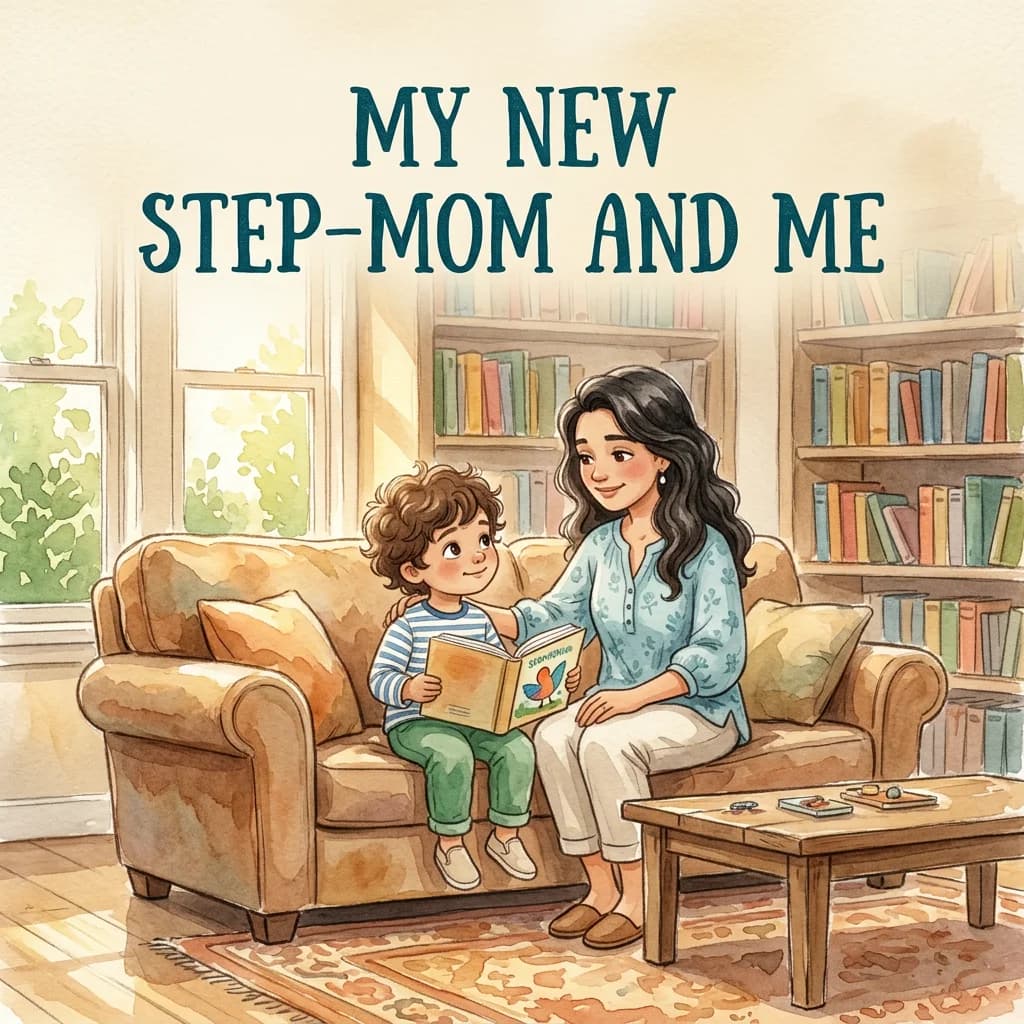
My New Step-Mom and Me
The meeting a step-mom story, rewritten for your child
Every page is redrawn around the child you make it for. Keep the story’s own hero and give them your child’s name, or choose someone new — it takes a minute, and nothing is locked in.
From$34.99 USD
Free to start. No payment to see your child in the story.
- 28 pages, hardcover
- 5.9 × 5.9 in
- Ages 3-5
- Premium, thick pages
- Free standard shipping included
- Printed & delivered in 2-3 weeks (US)
Start with the story’s own hero or pick from our cast — then give them your child’s name.
A gentle story helping young children warm up to a new stepmother — one small moment at a time.
That’s the story. The rest is how it becomes your child’s.
How personalization works
Who is this story about?

Keep the story’s own hero
The hero is already written and drawn for this book. Give them your child’s name if you like — that’s the whole edit.
Or swap in one of our cast
Eight characters to start from, and you rename whoever you pick.
- Luna

- Theo

- Mateo

- Sofia

- Amara

- Layla

- Mei

- Ravi

Or make your own
Describe them in a sentence, or add a photo to guide the likeness. Either way, entirely optional.
The characters are just the start.
Every part of this book is yours to change. Not a name dropped into a template — the whole thing is redrawn around the child you’re making it for.
- Every illustrationAll 28 pages are drawn fresh, not stamped with a face.
- The rooms and placesYour child's actual bedroom, your street, the places the story visits.
- The objects that recurThe specific blanket, the toy they won’t sleep without — carried page to page.
- Everyone else in itSiblings, grandparents, the dog. Named and drawn as themselves.
- The story itselfChange what happens, and the words on the page change with it.
- Or change nothingPick a hero and read it tonight. The rest is there when you want it.
What's Inside This Book
1 of 15 spreads
Every character, scene, and object in this book can be replaced with your own — your child's name, your family photos, your home, your school.
What you get
Free to start. No payment to see your child in the story.
Start free
- Free to start — no card needed
- See your child in the story in minutes
- Rename the hero and edit the story text
- Choose a ready-made character, or add a photo later
- Export a PDF of what you make
Your perfect keepsake
Hardcover book
- Full-color hardcover, 15×15cm
- Free standard shipping included
- Printed & delivered in about 2-3 weeks (US)
- Personalize names, story text & style
- Add your own photos once you are in the editor
Quick summary of My New Step-Mom and Me
This personalized book gently helps children aged 3–5 navigate meeting a new stepmother. Through everyday moments like shared meals and rainy-day puzzles, it models how trust and warmth can grow gradually — without pressure or big expectations.
This personalized children's book follows a child aged 3–5 as they cautiously get to know Sara, their dad's new partner. Featuring the child's own name alongside Sara and Dad, it reassures little ones that warming up slowly to someone new is completely natural.
Key Takeaways
- Normalizes cautious feelings toward new family members through a child's authentic perspective
- Models gradual trust-building through small shared moments like meals and rainy-day activities
- Reassures children that a stepparent doesn't replace anyone — Sara is simply 'just Sara'
- Encourages gratitude and connection through everyday acts of care and kindness
- Supports open family conversations by reflecting real blended-family experiences for ages 3–5
Why This Book Works
Psychologist Dr. Patricia Papernow's research on stepfamily development shows that young children need repeated, low-pressure positive interactions — not grand gestures — to build comfort with a new stepparent. This story mirrors that finding precisely. Sara doesn't declare love or try to replace a mum; she makes pancakes, finds a lost bunny, and does a puzzle. Each micro-moment accumulates into genuine warmth, which is exactly how trust forms in early childhood.
According to a 2020 review in the Journal of Family Psychology, children in blended families adjust best when they feel their ambivalence is acknowledged rather than dismissed. The book's opening line — "Sometimes new things take time. And that's perfectly okay." — does this directly. It validates the child's hesitation before a single page of story has passed, giving young readers immediate permission to feel however they feel without shame or pressure.
Bibliotherapy research led by Dr. Marianne Torbert at Temple University consistently shows that personalized narrative helps children rehearse real-life social situations more effectively than generic stories. When a child sees their own name navigating this exact scenario alongside their dad and their real stepmother's name, the book becomes a mirror — not a lesson. That distinction matters enormously for emotional processing at ages 3–5.
Common Misconceptions
Children should embrace a stepparent quickly or something is wrong.
Dr. Patricia Papernow's stepfamily research confirms the average adjustment period is 4–7 years. Gradual warming, as shown in this story, is developmentally healthy and normal for young children.
Talking about a stepparent confuses young children about family roles.
Research in Family Relations journal shows children benefit from clear, gentle conversations about new family members. Avoiding the topic creates more confusion than honest, age-appropriate discussion.
A picture book is too simple to help with blended family emotions.
Bibliotherapy studies show children aged 3–6 process complex emotions most effectively through narrative and illustration, making picture books one of the most powerful tools available to parents.
How to Read This Book with Your Child
Best time to read: Read during calm, connected moments — ideally a few days before or after a visit from the stepparent, not immediately before a difficult transition.
Before opening the book, ask your child what they already know about Sara (or use the real name). Normalise mixed feelings by saying something like, "It's okay to feel a bit unsure about new people — even grown-ups do." Keep the tone curious rather than instructional, so reading feels like exploring together.
Conversation Starters
- “What was your favourite thing Sara did in the story?”
- “Is there something small you and Sara could try together?”
- “It's okay to still be getting used to someone — does that feel true for you?”
Frequently Asked Questions
What age group is this book best suited for?
This book is designed for children aged 3–5. The simple vocabulary, short sentences, and focus on sensory everyday moments — pancakes, puzzles, bedtime — make it developmentally ideal for toddlers and preschoolers navigating a new blended family.
Can I use the real stepmother's name in the book?
Yes — that's the whole point of personalisation. Replacing "Sara" with the real person's name makes the story feel immediately relevant to your child, which research in bibliotherapy shows significantly increases emotional engagement and processing for young readers.
Should I read this before or after the stepparent moves in?
Either works, but timing matters. Reading it a few days before a significant transition gives children a mental script to draw on. Returning to it several weeks after can be equally valuable as feelings evolve.
What if my child says they don't like their stepmother after reading?
That's a healthy sign the book is working. Acknowledge the feeling calmly — "That makes sense, she's still new" — without correcting it. Dr. Patricia Papernow advises parents to validate ambivalence rather than rush reassurance, as this builds longer-term trust.
Is this book suitable for children who split time between two homes?
Absolutely. The story doesn't reference living arrangements, so it works for children who visit on weekends as much as those in a shared household. The emotional core — learning to feel safe with someone new — is universal across co-parenting situations.
The meeting a step-mom story, rewritten for your child
Free to start. No payment to see your child in the story.
You Might Also Like
More Stories Like This
Same-Sex Wedding Story
The Best Day: Uncle Jack and Uncle Marco's Wedding
A joyful wedding story told by the proudest flower girl ever — celebrating love, family, and the best day of all.
Same-Sex Wedding Day
The Best Day: Auntie Sara and Auntie Maya's Wedding
A joyful wedding story told by the child who scattered the petals — love, pride, and the best day ever.
Aunt and Uncle Wedding Day
The Day Auntie Sara Said Yes
A magical wedding story told by the flower girl — your child at the heart of the celebration.
Parents' Love Story
The Best Love Story Ever: Bedtime Stories of Mom and Dad
A warm keepsake book where your child narrates your love story — from how you met to your anniversary celebration.