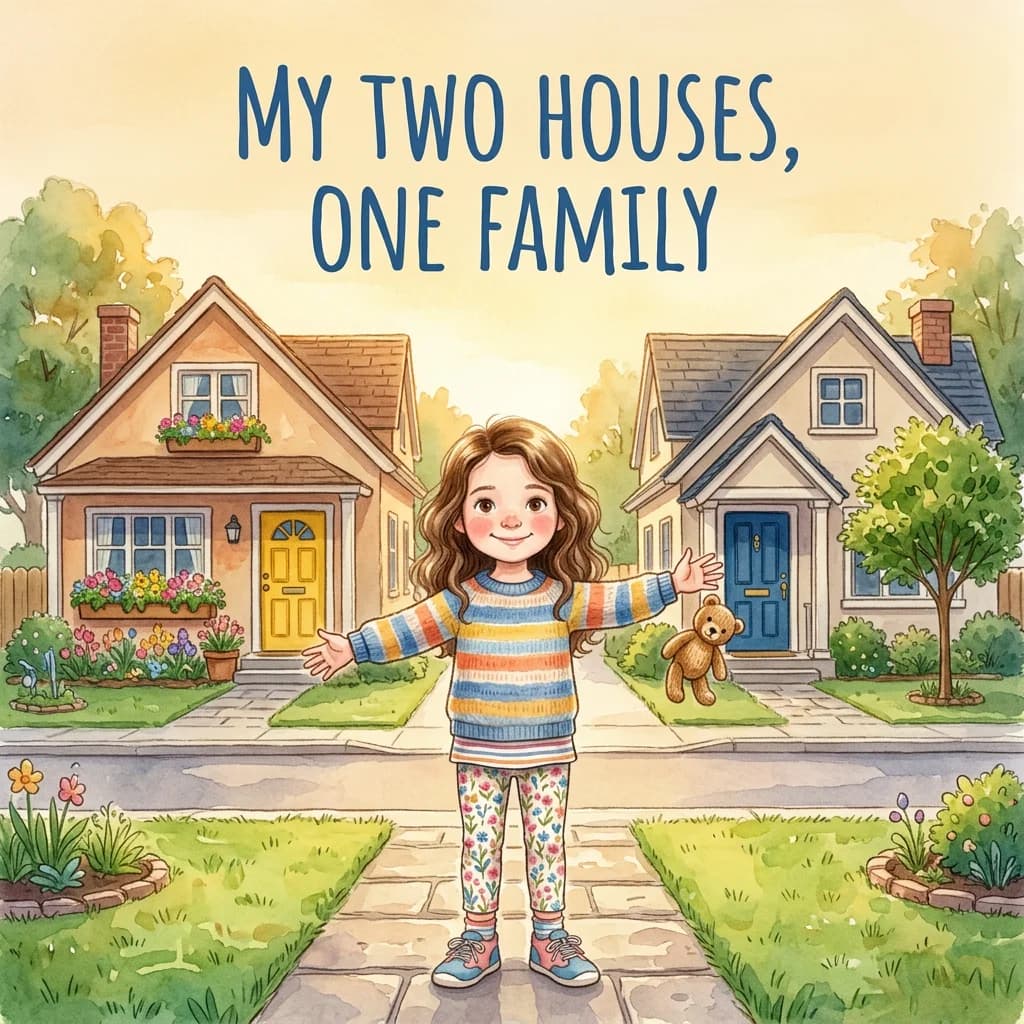
My Two Houses, One Family
A story about divorce separation, rewritten for your child
Every page is redrawn around the child you make it for. Keep the story’s own hero and give them your child’s name, or choose someone new — it takes a minute, and nothing is locked in.
From$34.99 USD
Free to start. No payment to see your child in the story.
- 28 pages, hardcover
- 5.9 × 5.9 in
- Ages 5-7
- Premium, thick pages
- Free standard shipping included
- Printed & delivered in 2-3 weeks (US)
Start with the story’s own hero or pick from our cast — then give them your child’s name.
A warm story for children navigating life between two loving homes after separation.
That’s the story. The rest is how it becomes your child’s.
How personalization works
Who is this story about?

Keep the story’s own hero
The hero is already written and drawn for this book. Give them your child’s name if you like — that’s the whole edit.
Or swap in one of our cast
Eight characters to start from, and you rename whoever you pick.
- Luna

- Theo

- Mateo

- Sofia

- Amara

- Layla

- Mei

- Ravi

Or make your own
Describe them in a sentence, or add a photo to guide the likeness. Either way, entirely optional.
The characters are just the start.
Every part of this book is yours to change. Not a name dropped into a template — the whole thing is redrawn around the child you’re making it for.
- Every illustrationAll 28 pages are drawn fresh, not stamped with a face.
- The rooms and placesYour child's actual bedroom, your street, the places the story visits.
- The objects that recurThe specific blanket, the toy they won’t sleep without — carried page to page.
- Everyone else in itSiblings, grandparents, the dog. Named and drawn as themselves.
- The story itselfChange what happens, and the words on the page change with it.
- Or change nothingPick a hero and read it tonight. The rest is there when you want it.
What's Inside This Book
1 of 15 spreads
Every character, scene, and object in this book can be replaced with your own — your child's name, your family photos, your home, your school.
What you get
Free to start. No payment to see your child in the story.
Start free
- Free to start — no card needed
- See your child in the story in minutes
- Rename the hero and edit the story text
- Choose a ready-made character, or add a photo later
- Export a PDF of what you make
Your perfect keepsake
Hardcover book
- Full-color hardcover, 15×15cm
- Free standard shipping included
- Printed & delivered in about 2-3 weeks (US)
- Personalize names, story text & style
- Add your own photos once you are in the editor
Quick summary of My Two Houses, One Family
This personalized children's book is for ages 5–7 whose parents are separated or divorced. It follows Mia as she moves between two homes, names the wobbly feelings, and discovers that having two houses means double the love — not half a family.
This personalized children's book follows Mia, ages 5–7, as she moves between Mum's and Dad's houses after a separation. Her stuffed rabbit, favourite bedroom details, and both parents' comfort rituals show that love travels with her everywhere she goes.
Key Takeaways
- Validates the 'wobbly' feeling of missing one parent while at the other's home
- Models healthy co-parenting reassurance through Mum's and Dad's gentle, consistent responses
- Reframes two-household life as 'double lucky' rather than broken or difficult
- Builds emotional vocabulary for children who struggle to name their in-between feelings
- Normalizes small transition frustrations — like packing a bag — without dramatising them
Why This Book Works
Personalized books that mirror a child's own living situation significantly reduce transition anxiety, according to Dr. Joan Kelly's landmark research on children and divorce adjustment. When Mia names the 'wobbly' feeling at each parent's house, children with two homes recognise themselves instantly. That recognition — 'this story is about me' — activates the emotional processing that general reassurance rarely reaches. The specific sensory details (glow-in-the-dark stars, banana bread smell) anchor comfort to both homes equally.
Co-regulation — a parent staying calm and present while a child feels distress — is one of the most evidence-backed tools in early emotional development, documented extensively by Dr. Dan Siegel in 'The Whole-Brain Child' (2011). Both Mum and Dad model this perfectly: neither dismisses Mia's feelings nor panics. Mum says 'It's okay to miss him — you love him. That's a good thing.' This script gives real parents a word-for-word model to borrow at bedtime.
The 'double lucky' reframe works because it is child-initiated, not parent-imposed — a distinction child psychologists consider critical for genuine resilience-building. Mia reaches the conclusion herself through observation, not instruction. A 2020 review in the journal 'Child Development Perspectives' found that internally generated positive reappraisal is far more durable than adult-directed reassurance in children aged 5–8. This story structures exactly that cognitive journey.
Common Misconceptions
Reading about divorce will upset children more
Research by Dr. Joan Kelly shows that naming and validating children's feelings about family change actually reduces anxiety — avoidance prolongs distress, not honest, age-appropriate stories.
Children aged 5–7 don't really notice the transition stress
Studies show children this age acutely feel loyalty conflicts between parents. They often mask distress to protect adults. Giving them a story character who feels 'wobbly' provides a safe, low-stakes outlet.
The book takes sides or implies one home is better
The story gives equal warmth, detail, and ritual to both houses — yellow bedroom versus blue bedroom, banana bread versus blanket forts — carefully balancing both parents' roles as loving caregivers.
How to Read This Book with Your Child
Best time to read: Read on the evening before a house transition, or on the first night at either home when your child seems unsettled or quiet.
Tell your child: 'This story is about a girl who has two homes, just like you.' Let them hold the book and notice both houses on the cover. Ask: 'What do you think she keeps in each bedroom?' This primes recognition without pressure.
Conversation Starters
- “What's your favourite thing about this house that you can't find at the other one?”
- “When you feel wobbly, what helps you feel better?”
- “Do you think Mia was really double lucky — and are you?”
Frequently Asked Questions
Is this book appropriate if the separation is recent?
Yes — in fact, it works best in the early months. The story normalises the 'wobbly' feeling without requiring children to have resolved anything yet. It opens conversation gently rather than rushing emotional closure.
What if my child cries when we read it?
Tears are a healthy sign the story is resonating. Sit with the feeling rather than rushing to fix it. Dr. Dan Siegel calls this 'connect before you redirect' — your calm presence during the emotion is the actual therapeutic moment, not finishing the book.
Can both parents use this book in their separate homes?
Absolutely — that's one of its strongest uses. When both Mum and Dad read the same story with the same reassuring lines, it creates a consistent emotional message across both households, which child psychologists identify as the single biggest predictor of healthy adjustment.
My child is 8 — is this too young for them?
The story works well up to age 9 for emotionally sensitive children. Older children may engage more with the reframe ('double lucky') than the emotional validation pages, but both elements remain meaningful beyond the stated age range.
How do I handle it if my child asks why we don't all live together?
Answer honestly at their level: 'Grown-ups sometimes love each other differently as time goes on, but we both love you exactly the same.' Avoid blaming the other parent. The book's message — love travels with you — is the best foundation for that conversation.
A story about divorce separation, rewritten for your child
Free to start. No payment to see your child in the story.
You Might Also Like
More Stories Like This
New Baby Welcome
Welcome to the World, Little One
A tender keepsake celebrating your newborn's arrival — perfect for the first days of wonder.
Getting Glasses for the First Time
My Wonderful New Glasses
A warm, reassuring story for children getting glasses — see the world through Mia's newly clear eyes.
Learning to Ride a Bike
Pedal by Pedal: Learning to Ride
A personalized bike-riding adventure celebrating every wobble, every fall, and the triumphant moment it all clicks.
Grandparent Bonding Days
Grandma and Me: Our Special Days
A warm, personalized keepsake celebrating every magical day spent with Grandma.