My Visual Schedule
Help your child feel calm and in control of their day
Unpredictable days are hard for little ones. This personalized story walks your child through their own daily routine, step by step, so transitions feel safe and familiar. Gentle for ages 3 to 5. Start free in minutes.
From$34.99 USD
Free to start. No payment to see your child in the story.
- 34 pages, hardcover
- 5.9 × 5.9 in
- Ages 3-5
- Premium, thick pages
- Free standard shipping included
- Printed & delivered in 2-3 weeks (US)
Start with the story’s own hero or pick from our cast — then give them your child’s name.
A personalized daily routine book that helps toddlers feel safe and confident knowing what comes next.
That’s the story. The rest is how it becomes your child’s.
How personalization works
Who is this story about?

Keep the story’s own hero
The hero is already written and drawn for this book. Give them your child’s name if you like — that’s the whole edit.
Or swap in one of our cast
Eight characters to start from, and you rename whoever you pick.
- Luna

- Theo

- Mateo

- Sofia

- Amara

- Layla

- Mei

- Ravi

Or make your own
Describe them in a sentence, or add a photo to guide the likeness. Either way, entirely optional.
The characters are just the start.
Every part of this book is yours to change. Not a name dropped into a template — the whole thing is redrawn around the child you’re making it for.
- Every illustrationAll 34 pages are drawn fresh, not stamped with a face.
- The rooms and placesYour child's actual bedroom, your street, the places the story visits.
- The objects that recurThe specific blanket, the toy they won’t sleep without — carried page to page.
- Everyone else in itSiblings, grandparents, the dog. Named and drawn as themselves.
- The story itselfChange what happens, and the words on the page change with it.
- Or change nothingPick a hero and read it tonight. The rest is there when you want it.
What's Inside This Book
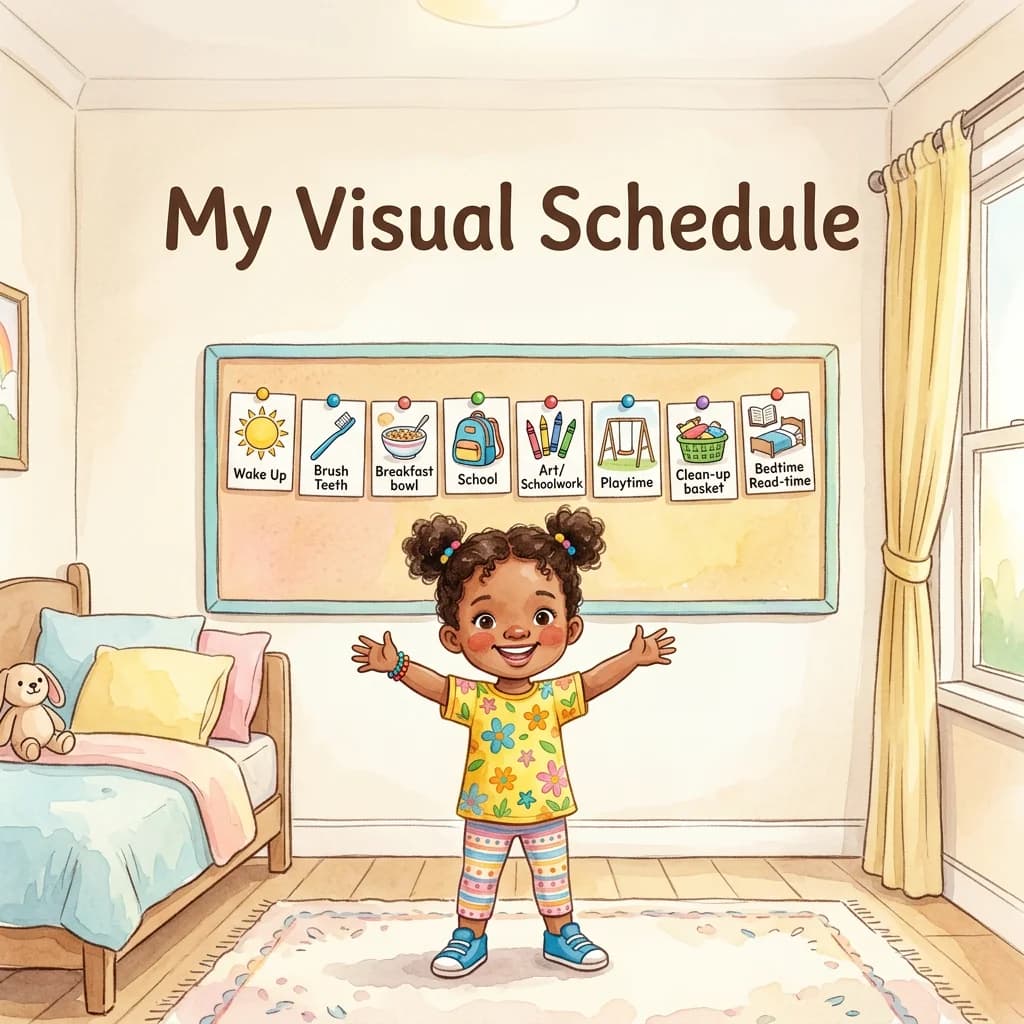
1 of 18 spreads
Every character, scene, and object in this book can be replaced with your own — your child's name, your family photos, your home, your school.
What you get
Free to start. No payment to see your child in the story.
Start free
- Free to start — no card needed
- See your child in the story in minutes
- Rename the hero and edit the story text
- Choose a ready-made character, or add a photo later
- Export a PDF of what you make
Your perfect keepsake
Hardcover book
- Full-color hardcover, 15×15cm
- Free standard shipping included
- Printed & delivered in about 2-3 weeks (US)
- Personalize names, story text & style
- Add your own photos once you are in the editor
Quick summary of My Visual Schedule
My Visual Schedule is a personalized daily routine book for toddlers ages 3-5 that uses pictures and visual cues to show what happens next in their day, helping them feel safe, confident, and more independent while reducing transitions anxiety and behavioral resistance.
This personalized children's book follows Maya (customized with your child's name) and family through a complete daily schedule for ages 3–5. From breakfast to bedtime, each activity is shown in sequence, helping young children feel calm and in control of their day.
Key Takeaways
- Builds daily routine confidence through a full morning-to-bedtime visual narrative
- Reduces transition anxiety by showing children exactly what activity comes next
- Strengthens self-regulation skills through predictable, repeated story exposure
- Models positive daily habits like tidying up, rest time, and family dinner
- Supports language development by naming each routine step clearly and consistently
Why This Book Works
Predictable routines are one of the most powerful tools for reducing anxiety in children aged 3–5, according to Dr. Ross Greene's research on collaborative problem-solving and child stress. When a child can anticipate what comes next, their stress response lowers significantly. Visual schedules work by externalizing the sequence — turning an abstract concept like 'what happens today' into something a child can see, touch, and trust. This book replicates that effect through story.
Personalization dramatically increases a young child's engagement with books, and that engagement accelerates learning, according to a 2018 study published in the journal Mind, Brain, and Education. When Maya shares your child's name, the story stops being fiction and becomes a mirror. Children self-identify with the character, making every routine modeled in the book feel personally relevant. That emotional hook is what makes habit-building through story so effective for toddlers and preschoolers.
The American Academy of Pediatrics recommends consistent daily routines as a core strategy for supporting emotional regulation in children under five. This book's structure — wake-up, meals, play, rest, outdoor time, bath, dinner, bed — follows evidence-backed routine sequencing. Reading it regularly reinforces neural pathways associated with routine compliance, making bedtime resistance and transition meltdowns measurably less frequent over time.
Common Misconceptions
Visual schedules are only useful for children with developmental delays
Research from the National Autism Center notes visual schedules benefit all young children by reducing cognitive load. Neurotypical 3–5 year olds show measurably fewer tantrums and smoother transitions when routines are visually anchored.
A story can't replace a real visual schedule on the wall
Stories reinforce rather than replace physical schedules. Reading this book primes children emotionally to accept routine, making any posted schedule far more effective. The two tools work best together.
Children this age are too young to follow a schedule
By age 3, children have the working memory to recall short sequences. Dr. Adele Diamond's research on executive function shows routine exposure at this age directly builds the prefrontal skills needed for self-regulation.
How to Read This Book with Your Child
Best time to read: Read this book as part of the morning routine or the night before a new week starts — timing it to real transitions maximizes its calming effect.
Tell your child, 'This book is about a day just like yours.' Point out their name on the cover. If you have a posted visual schedule at home, point to it before opening the book — this connects the story to their real routine and primes recognition.
Conversation Starters
- “What is your favourite part of your day, just like Maya's?”
- “Which part of the schedule feels hard sometimes — can we look at it together?”
- “What does Maya do after lunch? What do you do after lunch?”
Frequently Asked Questions
What age is this book best for?
My Visual Schedule is designed for toddlers and preschoolers ages 3-5 years old. It's especially helpful for children beginning preschool or daycare, or those who struggle with transitions and anxiety about routine changes.
How does a visual schedule help my toddler?
Visual schedules reduce anxiety by showing children exactly what happens next in their day. This predictability helps toddlers feel secure, transition more smoothly between activities, cooperate better during routines, and develop independence in self-care tasks.
Is this book personalized?
Yes! This book is designed to be personalized with your family's specific routines and activities. You can customize it with your child's actual daily sequence—whether that's breakfast, getting dressed, preschool, or bedtime—making it directly relevant to their life.
Can this help with separation anxiety or transitions?
Absolutely. Visual schedules are proven strategies recommended by child psychologists and occupational therapists for managing anxiety during transitions. Knowing what comes next helps toddlers feel in control and reduces resistance to changes throughout the day.
What makes this different from a regular routine chart?
Unlike poster charts, My Visual Schedule is a personalized storybook format that engages toddlers emotionally while teaching routines. It combines comfort, familiarity, and visual learning in a way that's more engaging and effective for young children.
How can teachers use this book in the classroom?
Teachers can use this book to help transition children between activities, manage group routines, and support children with anxiety or behavioral challenges. It's an effective tool for classroom management and supporting individual children's emotional needs.
Help your child feel calm and in control of their day
Free to start. No payment to see your child in the story.
You Might Also Like
More Stories Like This
New Baby Welcome
Welcome to the World, Little One
A tender keepsake celebrating your newborn's arrival — perfect for the first days of wonder.
Getting Glasses for the First Time
My Wonderful New Glasses
A warm, reassuring story for children getting glasses — see the world through Mia's newly clear eyes.
Learning to Ride a Bike
Pedal by Pedal: Learning to Ride
A personalized bike-riding adventure celebrating every wobble, every fall, and the triumphant moment it all clicks.
Grandparent Bonding Days
Grandma and Me: Our Special Days
A warm, personalized keepsake celebrating every magical day spent with Grandma.