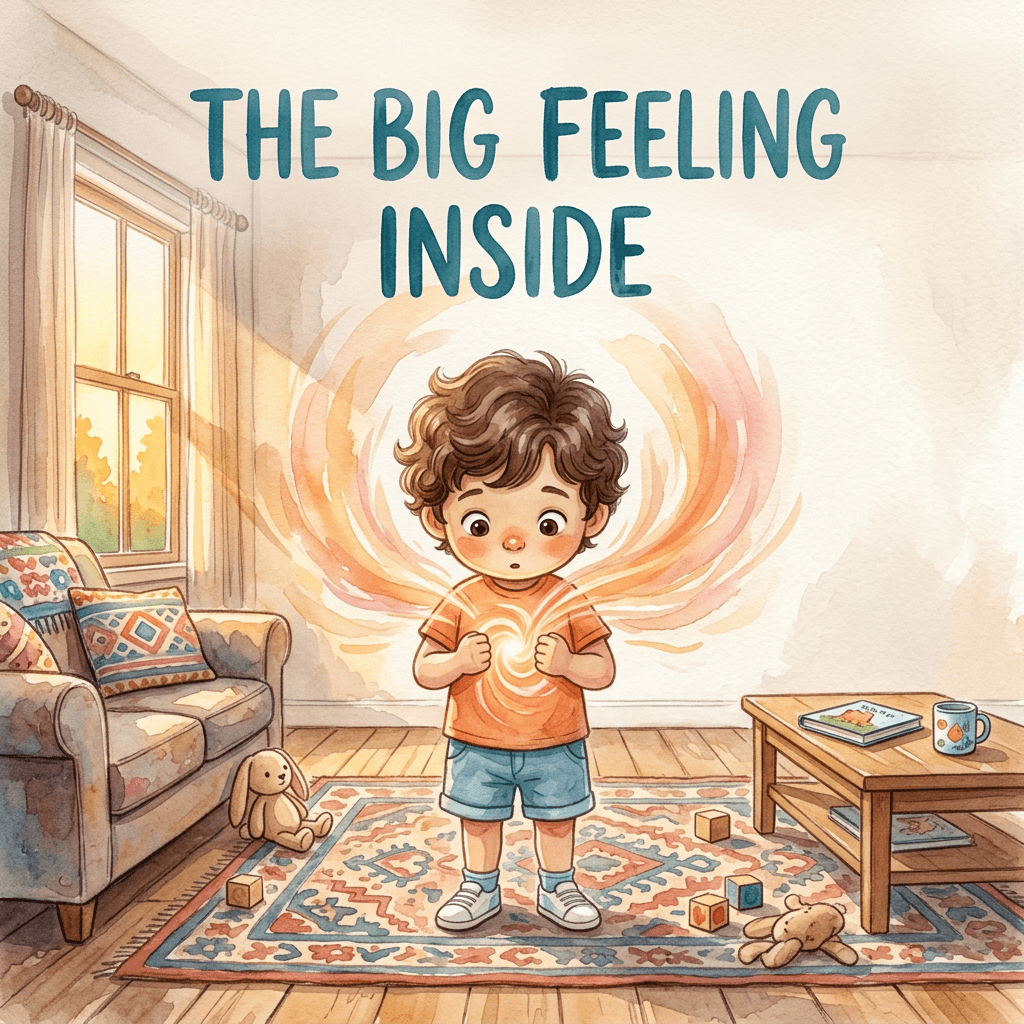
The Big Feeling Inside
The understanding anger story, rewritten for your child
Every page is redrawn around the child you make it for. Keep the story’s own hero and give them your child’s name, or choose someone new — it takes a minute, and nothing is locked in.
From$34.99 USD
Free to start. No payment to see your child in the story.
- 34 pages, hardcover
- 5.9 × 5.9 in
- Ages 3-5
- Premium, thick pages
- Free standard shipping included
- Printed & delivered in 2-3 weeks (US)
Start with the story’s own hero or pick from our cast — then give them your child’s name.
A gentle story helping ages 3–5 name anger, breathe through it, and feel understood.
That’s the story. The rest is how it becomes your child’s.
How personalization works
Who is this story about?

Keep the story’s own hero
The hero is already written and drawn for this book. Give them your child’s name if you like — that’s the whole edit.
Or swap in one of our cast
Eight characters to start from, and you rename whoever you pick.
- Luna

- Theo

- Mateo

- Sofia

- Amara

- Layla

- Mei

- Ravi

Or make your own
Describe them in a sentence, or add a photo to guide the likeness. Either way, entirely optional.
The characters are just the start.
Every part of this book is yours to change. Not a name dropped into a template — the whole thing is redrawn around the child you’re making it for.
- Every illustrationAll 34 pages are drawn fresh, not stamped with a face.
- The rooms and placesYour child's actual bedroom, your street, the places the story visits.
- The objects that recurThe specific blanket, the toy they won’t sleep without — carried page to page.
- Everyone else in itSiblings, grandparents, the dog. Named and drawn as themselves.
- The story itselfChange what happens, and the words on the page change with it.
- Or change nothingPick a hero and read it tonight. The rest is there when you want it.
What's Inside This Book
1 of 18 spreads
Every character, scene, and object in this book can be replaced with your own — your child's name, your family photos, your home, your school.
What you get
Free to start. No payment to see your child in the story.
Start free
- Free to start — no card needed
- See your child in the story in minutes
- Rename the hero and edit the story text
- Choose a ready-made character, or add a photo later
- Export a PDF of what you make
Your perfect keepsake
Hardcover book
- Full-color hardcover, 15×15cm
- Free standard shipping included
- Printed & delivered in about 2-3 weeks (US)
- Personalize names, story text & style
- Add your own photos once you are in the editor
Quick summary of The Big Feeling Inside
The Big Feeling Inside is a compassionate picture book that helps preschoolers (ages 3-5) understand anger, validate their emotions, and learn practical breathing techniques to calm down. It normalizes big feelings while teaching healthy coping strategies.
This personalized children's book follows Milo, ages 3–5, through a rising wave of anger — from tight tummy to stomping feet. With Mama and Daddy present, Milo learns to name anger, use calming strategies, and feel reassured that big feelings don't make you bad.
Key Takeaways
- Builds emotional vocabulary by naming anger as a normal, human experience
- Teaches a four-step regulation sequence: stop, breathe, move, then talk
- Reduces shame through explicit messaging that anger does not make a child bad
- Models caregiver co-regulation with Mama and Daddy actively listening and validating
- Strengthens body awareness by connecting anger to physical sensations like tight tummies
Why This Book Works
Naming an emotion before managing it is the neurological prerequisite for self-regulation, according to Dr. Dan Siegel's 'name it to tame it' framework. When Milo identifies the sensation as 'ANGER,' the prefrontal cortex begins to regain control over the amygdala's fight-or-flight response. For children ages 3–5, hearing an emotion labeled in story form activates this same pathway — building the neural circuitry they'll rely on for decades.
The four-step sequence in this book — stop, breathe, move, talk — mirrors the evidence-based protocol used in Dr. John Gottman's Emotion Coaching research, which found that children with emotion-coaching parents had fewer behavior problems and better physical health. Physical movement, like stomping or shaking hands, provides a legitimate outlet for the cortisol and adrenaline that flood a child's body during anger. This isn't distraction — it's physiology.
Shame is the hidden accelerant of childhood anger, and this story directly dismantles it by repeating that anger is universal and that the child is 'wonderful, just as you are.' A 2019 review in the journal Child Development found that children who experienced shame after emotional outbursts showed higher aggression over time, not less. By pairing caregiver validation with actionable tools, this book interrupts that cycle early.
Common Misconceptions
Letting kids express anger will make tantrums worse
Dr. John Gottman's research shows the opposite — children whose emotions are validated, not dismissed, develop better self-control over time, not less.
Three-year-olds are too young to learn anger strategies
By age 3, children can begin learning simple regulation steps. The American Academy of Pediatrics confirms preschoolers respond well to body-based strategies like deep breathing and movement.
Books can't calm an angry child in the moment
Read proactively — not during a meltdown — books build the memory traces children draw on when real anger strikes. Prevention, not rescue, is the goal.
How to Read This Book with Your Child
Best time to read: Read during a calm, connected moment — not during or immediately after a tantrum. Bedtime or after a quiet snack works well.
Tell your child: 'This story is about a feeling you've probably had before.' Ask them to point to where they feel big feelings in their body — belly, chest, hands. This primes body awareness before the story introduces it, making the connection feel personal rather than instructional.
Conversation Starters
- “Where in your body do you feel anger when it starts to grow?”
- “Which step do you think would be hardest — stopping, breathing, or moving?”
- “What would you want Mama or Daddy to do when your feeling gets really big?”
Frequently Asked Questions
Is this book appropriate for my 3-year-old who gets angry easily?
Yes, The Big Feeling Inside is designed specifically for ages 3-5 and uses simple, accessible language to help toddlers understand anger. It's gentle and non-judgmental, helping children feel understood rather than ashamed of their emotions.
How does this book teach kids to manage anger?
The story introduces simple breathing exercises and calming techniques that preschoolers can actually use when they feel angry. Through relatable characters and situations, children learn that big feelings are normal and manageable.
Can teachers use this book in the classroom?
Absolutely. This book is excellent for classrooms and daycare settings. It opens conversations about emotions, provides a shared vocabulary for feelings, and gives all children tools for self-regulation in group settings.
What makes this different from other emotion books for young kids?
The Big Feeling Inside specifically focuses on anger (not just general emotions) and pairs emotional validation with concrete, age-appropriate coping strategies like breathing. It helps kids feel understood while building real skills.
Will this book help reduce my child's tantrums?
While reading one book won't eliminate tantrums, it's a valuable tool that helps children develop emotional awareness and coping skills over time. Used consistently, it supports behavioral development and parent-child communication about feelings.
Is the content too intense for sensitive children?
No. The Big Feeling Inside uses a warm, gentle approach that validates feelings without overwhelming young children. It's designed to be soothing and reassuring rather than confrontational about anger.
The understanding anger story, rewritten for your child
Free to start. No payment to see your child in the story.