The Festival of Lights
The celebrating diwali together story, rewritten for your child
Every page is redrawn around the child you make it for. Keep the story’s own hero and give them your child’s name, or choose someone new — it takes a minute, and nothing is locked in.
From$34.99 USD
Free to start. No payment to see your child in the story.
- 36 pages, hardcover
- 5.9 × 5.9 in
- Ages 5-7
- Premium, thick pages
- Free standard shipping included
- Printed & delivered in 2-3 weeks (US)
Start with the story’s own hero or pick from our cast — then give them your child’s name.
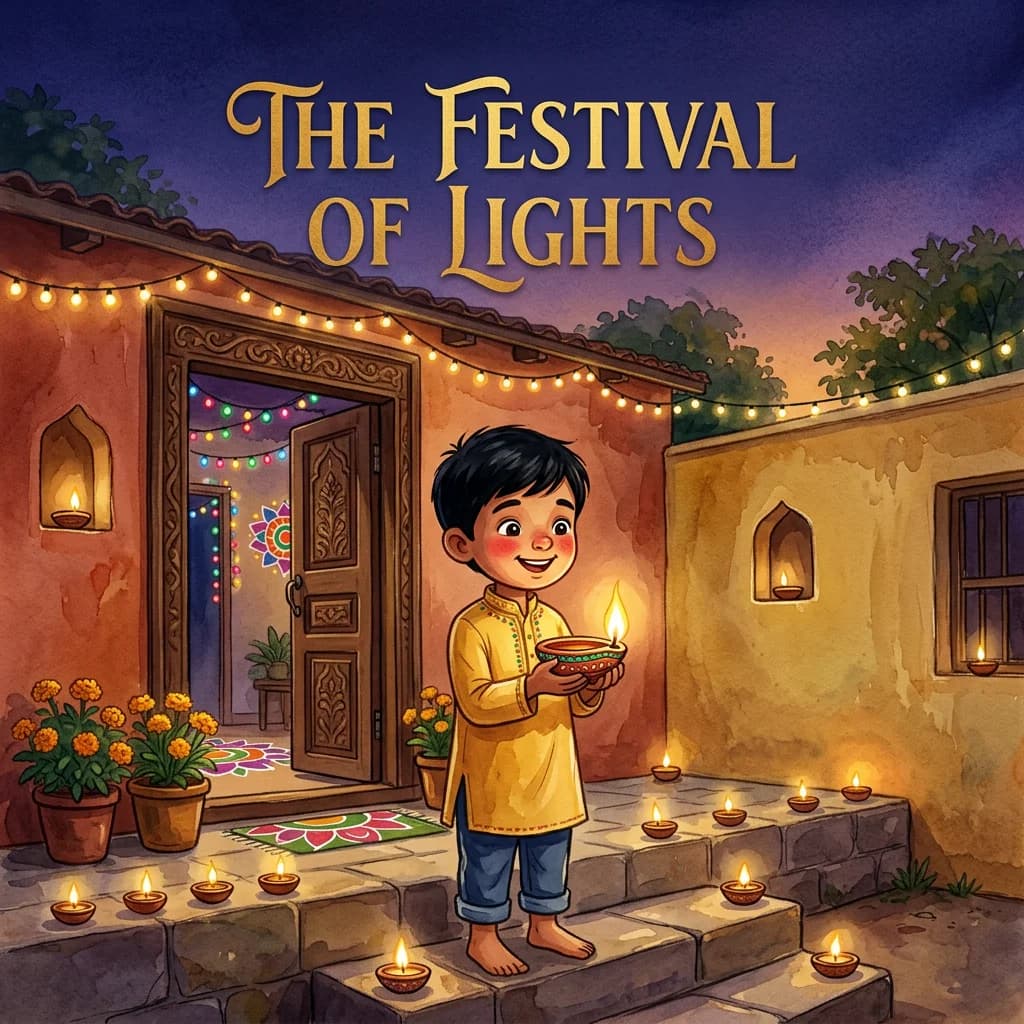
A warm Diwali story starring your child — diyas, rangoli, fireworks, and family love await.
That’s the story. The rest is how it becomes your child’s.
How personalization works
Who is this story about?

Keep the story’s own hero
The hero is already written and drawn for this book. Give them your child’s name if you like — that’s the whole edit.
Or swap in one of our cast
Eight characters to start from, and you rename whoever you pick.
- Luna

- Theo

- Mateo

- Sofia

- Amara

- Layla

- Mei

- Ravi

Or make your own
Describe them in a sentence, or add a photo to guide the likeness. Either way, entirely optional.
The characters are just the start.
Every part of this book is yours to change. Not a name dropped into a template — the whole thing is redrawn around the child you’re making it for.
- Every illustrationAll 36 pages are drawn fresh, not stamped with a face.
- The rooms and placesYour child's actual bedroom, your street, the places the story visits.
- The objects that recurThe specific blanket, the toy they won’t sleep without — carried page to page.
- Everyone else in itSiblings, grandparents, the dog. Named and drawn as themselves.
- The story itselfChange what happens, and the words on the page change with it.
- Or change nothingPick a hero and read it tonight. The rest is there when you want it.
What's Inside This Book
1 of 19 spreads
Every character, scene, and object in this book can be replaced with your own — your child's name, your family photos, your home, your school.
What you get
Free to start. No payment to see your child in the story.
Start free
- Free to start — no card needed
- See your child in the story in minutes
- Rename the hero and edit the story text
- Choose a ready-made character, or add a photo later
- Export a PDF of what you make
Your perfect keepsake
Hardcover book
- Full-color hardcover, 15×15cm
- Free standard shipping included
- Printed & delivered in about 2-3 weeks (US)
- Personalize names, story text & style
- Add your own photos once you are in the editor
Quick summary of The Festival of Lights
This personalized Diwali book follows Arjun — your child — as he helps his family decorate with diyas, create rangoli, watch fireworks, and share mithai. It's designed for children aged 5–7 to explore Diwali traditions through warm storytelling and family connection.
This personalized children's book places your child at the heart of Diwali celebrations, ages 5–7. Alongside Mama, Papa, and Dadi, they light diyas, paint rangoli, enjoy mithai, and discover the meaning behind the Festival of Lights — all woven into a 36-page keepsake story.
Key Takeaways
- Nurtures cultural pride through immersive, child-centered Diwali storytelling
- Introduces key traditions — diyas, rangoli, puja, mithai — in natural, joyful context
- Sparks intergenerational connection by centering Dadi's wisdom as a story anchor
- Builds vocabulary around Hindu festivals with context-rich narrative, not a glossary
- Carries a lasting emotional truth: even the smallest light can push away the darkness
Why This Book Works
Personalized books measurably increase reading engagement — a 2016 study by the National Literacy Trust found children were 40% more likely to finish a book featuring their own name. When Arjun is your child, the diya they light on page 19 feels like their flame. That personal stake transforms passive reading into active meaning-making — exactly what early literacy researchers call 'self-to-text connection,' a key predictor of comprehension.
Cultural identity development in early childhood is strongly tied to self-esteem — Dr. Haeny Yoon of Columbia University notes that children who see their family's traditions mirrored in books develop stronger cultural confidence by age 8. This story doesn't explain Diwali from the outside; it places your child inside the celebration, filling rangoli petals and watching fireworks burst. That insider perspective is what makes the learning stick — and the pride grow.
The book's emotional core — Dadi whispering 'even the smallest light can push away the darkness' — anchors an abstract idea in a concrete, memorable image that child development experts call a 'narrative hook.' Dr. Jerome Bruner's research on narrative cognition found that children retain moral concepts significantly better when embedded in story rather than instruction. Arjun's moment of quiet understanding on page 33 invites your child to have the same realisation — gently, at their own pace.
Common Misconceptions
Diwali books are only useful for Hindu families
Educators widely recommend culturally specific books for all children. Exposure to other families' traditions builds empathy and global awareness — skills the American Academy of Pediatrics links to better social outcomes in early childhood.
Young children won't grasp the spiritual meaning of Diwali
Children aged 5–7 readily absorb symbolic meaning through story. Dadi's explanation — 'the smallest light pushes away darkness' — uses concrete imagery that developmental psychologists confirm is ideal for this age group's thinking style.
Personalized books are just gimmicks — the story matters more
Research from the University of Sussex (2019) found personalized books produced significantly higher engagement and recall compared to identical non-personalized versions, suggesting the name integration enhances rather than replaces narrative quality.
How to Read This Book with Your Child
Best time to read: Read in the week leading up to Diwali for maximum relevance, or any evening when you want a warm, culturally rich bedtime story.
Show your child a real diya or a photo of rangoli before opening the book. Ask: 'Have you ever seen lights like these?' If your family celebrates Diwali, bring out a relevant object — sweets, a clay lamp — to ground the story in real sensory memory before page one.
Conversation Starters
- “What would you put on your rangoli if you could choose any colours?”
- “Why do you think Dadi says even a tiny light matters?”
- “If your family had a special celebration, what would you want to do together?”
Frequently Asked Questions
Is this Diwali book suitable for non-Hindu children too?
Absolutely — this book works beautifully as both a mirror and a window. For Hindu families it validates their traditions; for other families it builds cultural empathy. Educators and the American Library Association consistently recommend culturally specific stories for all young readers aged 5–7.
Can I change the character names to match my own family?
Yes. MoonShine Story's personalization lets you customize the child's name and key family members, so Arjun becomes your child and Dadi can reflect your family's own relationship names. The story's warmth stays completely intact.
What Diwali traditions does this book actually cover?
The book covers diyas (clay oil lamps), rangoli (coloured powder art), puja (prayer and thanksgiving), mithai (traditional sweets including laddoos and chakli), and fireworks. Each tradition is introduced naturally through story rather than as a lesson, making it ideal for ages 5–7.
Will a 5-year-old understand the meaning behind Diwali in this book?
Yes. The story uses Dadi's whisper — 'even the smallest light can push away the darkness' — as an accessible emotional anchor. Dr. Jerome Bruner's research confirms children this age retain moral ideas far better through narrative imagery than direct explanation.
When is the best time to read this book with my child?
Read it in the days leading up to Diwali for the richest experience, ideally in the evening when you can light a candle together afterward. It also works year-round as a warm bedtime story celebrating family togetherness and cultural heritage.
The celebrating diwali together story, rewritten for your child
Free to start. No payment to see your child in the story.
You Might Also Like
More Stories Like This
New Baby Welcome
Welcome to the World, Little One
A tender keepsake celebrating your newborn's arrival — perfect for the first days of wonder.
Getting Glasses for the First Time
My Wonderful New Glasses
A warm, reassuring story for children getting glasses — see the world through Mia's newly clear eyes.
Learning to Ride a Bike
Pedal by Pedal: Learning to Ride
A personalized bike-riding adventure celebrating every wobble, every fall, and the triumphant moment it all clicks.
Grandparent Bonding Days
Grandma and Me: Our Special Days
A warm, personalized keepsake celebrating every magical day spent with Grandma.