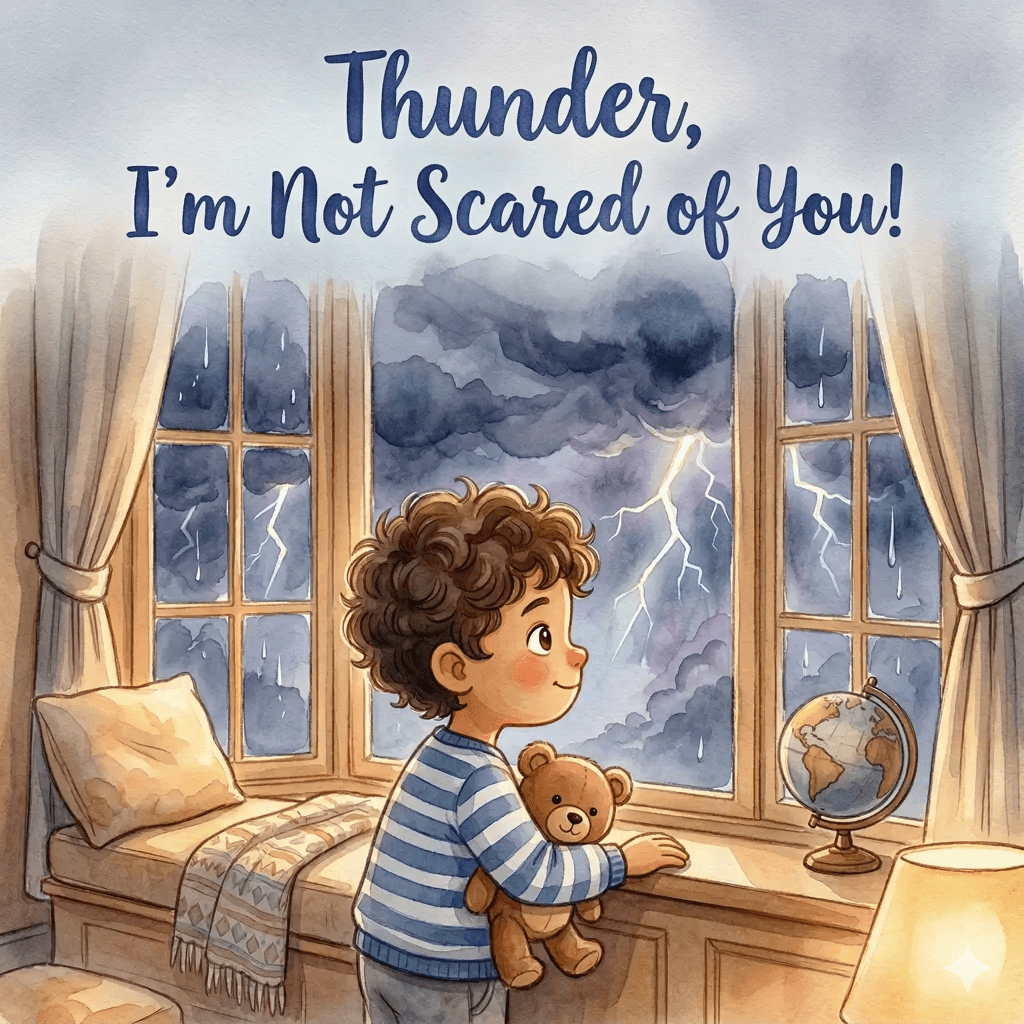
Thunder, I'm Not Scared of You!
The thunder storm anxiety story, rewritten for your child
Every page is redrawn around the child you make it for. Keep the story’s own hero and give them your child’s name, or choose someone new — it takes a minute, and nothing is locked in.
From$34.99 USD
Free to start. No payment to see your child in the story.
- 30 pages, hardcover
- 5.9 × 5.9 in
- Ages 3-5
- Premium, thick pages
- Free standard shipping included
- Printed & delivered in 2-3 weeks (US)
Start with the story’s own hero or pick from our cast — then give them your child’s name.
A personalized story helping children ages 3–5 conquer fear of thunderstorms with Milo, Mama, and brave counting strategies.
That’s the story. The rest is how it becomes your child’s.
How personalization works
Who is this story about?

Keep the story’s own hero
The hero is already written and drawn for this book. Give them your child’s name if you like — that’s the whole edit.
Or swap in one of our cast
Eight characters to start from, and you rename whoever you pick.
- Luna

- Theo

- Mateo

- Sofia

- Amara

- Layla

- Mei

- Ravi

Or make your own
Describe them in a sentence, or add a photo to guide the likeness. Either way, entirely optional.
The characters are just the start.
Every part of this book is yours to change. Not a name dropped into a template — the whole thing is redrawn around the child you’re making it for.
- Every illustrationAll 30 pages are drawn fresh, not stamped with a face.
- The rooms and placesYour child's actual bedroom, your street, the places the story visits.
- The objects that recurThe specific blanket, the toy they won’t sleep without — carried page to page.
- Everyone else in itSiblings, grandparents, the dog. Named and drawn as themselves.
- The story itselfChange what happens, and the words on the page change with it.
- Or change nothingPick a hero and read it tonight. The rest is there when you want it.
What's Inside This Book
1 of 16 spreads
Every character, scene, and object in this book can be replaced with your own — your child's name, your family photos, your home, your school.
What you get
Free to start. No payment to see your child in the story.
Start free
- Free to start — no card needed
- See your child in the story in minutes
- Rename the hero and edit the story text
- Choose a ready-made character, or add a photo later
- Export a PDF of what you make
Your perfect keepsake
Hardcover book
- Full-color hardcover, 15×15cm
- Free standard shipping included
- Printed & delivered in about 2-3 weeks (US)
- Personalize names, story text & style
- Add your own photos once you are in the editor
Quick summary of Thunder, I'm Not Scared of You!
Thunder, I'm Not Scared of You! is a personalized storybook for ages 3-5 that helps children overcome thunderstorm anxiety through the adventures of Milo, his mama, and brave counting strategies. It normalizes fear while teaching practical coping skills.
This personalized children's book helps children ages 3-5 conquer their fear of thunderstorms through the story of Milo, who learns brave counting strategies with Mama's support. Featuring evidence-based coping techniques from developmental psychology, the book can be personalized with your child's name, photos, and family details to make the experience deeply personal and effective.
Key Takeaways
- Builds storm coping skills through an evidence-based counting strategy between lightning and thunder
- Models healthy emotion coaching via Mama's co-regulation approach (not dismissing or amplifying fear)
- Personalizable with your child's name, photos, and family members for maximum emotional impact
- Designed for ages 3-5 during the peak window for fear acquisition and resolution
- Supports 3-5 repeat readings to internalize coping strategies before real storms
Why This Book Works
Research in developmental psychology confirms that children ages 3–5 are in a prime window for fear acquisition and fear resolution. At this stage, the amygdala — the brain's fear center — is highly active, while the prefrontal cortex responsible for rational regulation is still maturing. Stories like Thunder, I'm Not Scared of You! act as a 'cognitive bridge,' giving children a narrative framework to process intense emotions before they experience them in real time.
Milo's coping strategy of counting between thunder and lightning is grounded in evidence-based behavioral techniques. Counting creates a predictable, controllable action during an unpredictable event — directly addressing what psychologists call 'perceived uncontrollability,' a primary driver of childhood anxiety. When children rehearse this strategy through story, they are neurologically priming themselves to use it during actual storms, a process known as mental simulation or narrative rehearsal.
Mama's response in the story models what attachment theorists call 'emotion coaching' — she neither dismisses Milo's fear ('It's nothing!') nor amplifies it ('I know, it's so scary!'). Instead, she co-regulates, sitting beside him and offering both physical presence and psychoeducation. Studies by Dr. John Gottman show that children whose caregivers practice emotion coaching develop stronger emotional intelligence and recover from fear faster.
The story's resolution — a rainbow after the storm — is developmentally intentional. For ages 3–5, concrete, visual rewards anchor emotional learning. The rainbow signals that discomfort is temporary and that persistence through fear yields beauty. This narrative arc reinforces a growth mindset around bravery, aligning with Carol Dweck's research on how children develop resilient self-concepts when effort and strategy — not just innate traits — are highlighted.
Common Misconceptions
Telling a child 'there's nothing to be scared of' will make their storm fear go away.
Dismissing fear often intensifies it. When children feel unheard, their nervous system escalates rather than calms. Emotion coaching — acknowledging the fear and then offering tools — is consistently more effective at reducing anxiety than reassurance alone, according to research by psychologist Dr. Lynn Lyons.
Children will grow out of thunderstorm phobia on their own without any intervention.
While some fears do naturally diminish, untreated specific fears in early childhood can solidify into phobias by middle childhood if not addressed. Providing coping strategies between ages 3–5 — when the brain is most neuroplastic — gives children the best window to rewire fear responses into manageable reactions.
Letting a child hide under their blanket during a storm is just enabling avoidance.
Brief comfort-seeking is a healthy first response and does not indicate avoidance pathology in young children. The key, as modeled by Mama in this story, is to gently introduce active coping strategies alongside comfort — not instead of it. Complete avoidance without coping tools is the concern; comfort plus skill-building is the goal.
A book about thunderstorms might make a child more anxious about them.
Bibliotherapy research consistently shows that reading about a feared topic in a safe, calm context reduces rather than amplifies fear. The story creates a 'low-stakes exposure' experience — children engage with the idea of thunder while feeling secure, which gradually desensitizes the fear response through what psychologists call graduated exposure.
How to Read This Book with Your Child
Best time to read: Read this book for the first time on a calm, sunny day — not during or immediately before a storm. Repeat readings are highly valuable; children ages 3–5 benefit from hearing the same story 3–5 times before the coping strategies feel internalized. Once your child knows the story well, you can reference it during an actual storm: 'Remember what Milo did? Let's count together just like him.' This activates the narrative memory your child has already built.
Choose a calm, cozy moment to introduce this book — ideally not in the middle of an actual storm, but during a relaxed day. Sit close together so your child feels physically secure. You might say, 'I found a story about a boy named Milo who hears a really big sound in the sky — shall we find out what happens?' This low-key framing invites curiosity rather than priming anxiety. If your child has recently had a frightening storm experience, briefly acknowledge it: 'Remember when we heard that big thunder? Let's see what Milo does when that happens to him.'
Conversation Starters
- “Milo felt really scared when he heard the thunder. Has your tummy ever felt scared like that? What did it feel like?”
- “Mama stayed right next to Milo. Who makes you feel safe when something is scary?”
- “Milo learned to count and breathe when thunder came. What do you think YOU could do the next time you hear a big sound?”
Frequently Asked Questions
At what age is this book most effective?
This book is designed for ages 3-5 (preschool), when children begin to develop awareness of their emotions and can learn simple coping strategies. It works best when read together with a parent or caregiver who can reinforce the strategies.
Will this book actually help my child feel less scared?
Yes. By normalizing fear through relatable storytelling and teaching specific counting strategies, children gain both emotional validation and practical tools. Most children benefit from repeated readings that build confidence over time.
What coping strategies does the book teach?
The book introduces brave counting as a primary coping strategy, which helps redirect attention and give children a sense of control during storms. It also emphasizes the reassurance of a caring adult nearby, building emotional safety.
Can this book help with other fears besides thunderstorms?
While specifically designed for storm anxiety, the counting and reassurance strategies can transfer to other situations. Parents can adapt the techniques for various child anxieties with guidance from the book's framework.
Is this book suitable for children with serious anxiety disorders?
This book is excellent for typical developmental fears. For children with diagnosed anxiety disorders, it complements professional support but shouldn't replace guidance from a pediatrician or child therapist.
How many times should we read this book?
Reading before storm season arrives helps children prepare mentally. Repeat readings (even during calm weather) build confidence. During actual storms, revisiting the book or practicing the counting strategy together provides comfort and reassurance.
The thunder storm anxiety story, rewritten for your child
Free to start. No payment to see your child in the story.
You Might Also Like
More Stories Like This
Fire Drill Anxiety
When the Bell Rings: A Personalized Fire Drill Book for Kids
Help your child feel calm and brave when the fire alarm rings at school.
Making First Friends
Hello, New Friend!
A gentle, joyful story that gives shy 3–5 year olds the courage to say hello first.
First Sleepover Away From Home
The Brave Sleepover
A personalized first-sleepover book that turns homesickness into courage — one cozy night at a time.