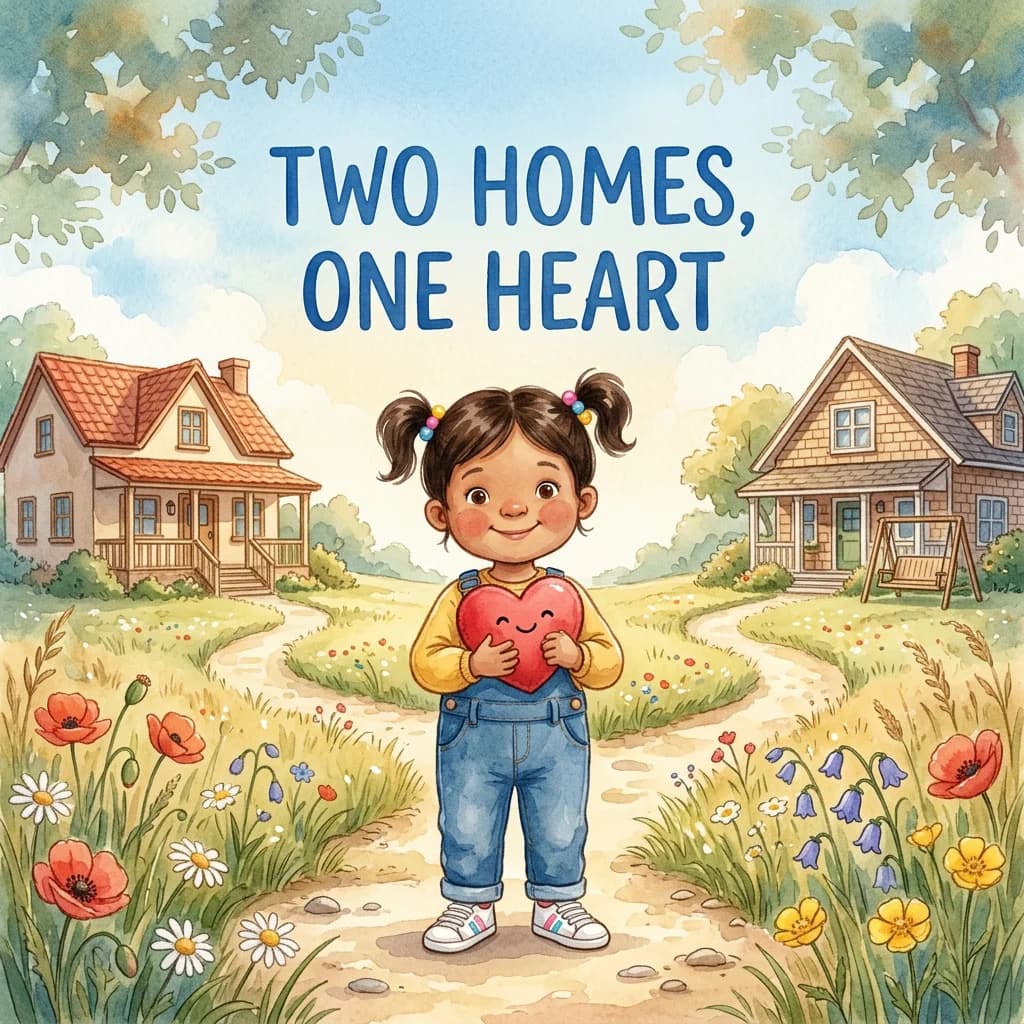
Two Homes, One Heart
Help your child know they are loved in both homes
Two homes is a lot for a small heart to hold. This gentle personalized story names your child as Mia, showing them that love travels with them between both homes and never runs out. Ages 3 to 5. Start free in minutes.
From$34.99 USD
Free to start. No payment to see your child in the story.
- 28 pages, hardcover
- 5.9 × 5.9 in
- Ages 3-5
- Premium, thick pages
- Free standard shipping included
- Printed & delivered in 2-3 weeks (US)
Start with the story’s own hero or pick from our cast — then give them your child’s name.
A warm, reassuring story for children navigating life between two loving homes.
That’s the story. The rest is how it becomes your child’s.
How personalization works
Who is this story about?

Keep the story’s own hero
The hero is already written and drawn for this book. Give them your child’s name if you like — that’s the whole edit.
Or swap in one of our cast
Eight characters to start from, and you rename whoever you pick.
- Luna

- Theo

- Mateo

- Sofia

- Amara

- Layla

- Mei

- Ravi

Or make your own
Describe them in a sentence, or add a photo to guide the likeness. Either way, entirely optional.
The characters are just the start.
Every part of this book is yours to change. Not a name dropped into a template — the whole thing is redrawn around the child you’re making it for.
- Every illustrationAll 28 pages are drawn fresh, not stamped with a face.
- The rooms and placesYour child's actual bedroom, your street, the places the story visits.
- The objects that recurThe specific blanket, the toy they won’t sleep without — carried page to page.
- Everyone else in itSiblings, grandparents, the dog. Named and drawn as themselves.
- The story itselfChange what happens, and the words on the page change with it.
- Or change nothingPick a hero and read it tonight. The rest is there when you want it.
What's Inside This Book
1 of 15 spreads
Every character, scene, and object in this book can be replaced with your own — your child's name, your family photos, your home, your school.
What you get
Free to start. No payment to see your child in the story.
Start free
- Free to start — no card needed
- See your child in the story in minutes
- Rename the hero and edit the story text
- Choose a ready-made character, or add a photo later
- Export a PDF of what you make
Your perfect keepsake
Hardcover book
- Full-color hardcover, 15×15cm
- Free standard shipping included
- Printed & delivered in about 2-3 weeks (US)
- Personalize names, story text & style
- Add your own photos once you are in the editor
Quick summary of Two Homes, One Heart
Two Homes, One Heart is a personalized picture book for ages 3–5 about a child living between two homes after parents separate. It validates mixed emotions, offers comforting reassurances from both parents, and celebrates the love that never changes — no matter where a child sleeps.
This personalized children's book follows Mia, aged 3–5, as she navigates life between Mama's and Daddy's homes after separation. Featuring both parents as loving characters, the story validates big feelings while reassuring children that love travels with them everywhere they go.
Key Takeaways
- Validates the sadness of missing a parent through warm, age-appropriate emotional language
- Builds emotional vocabulary by naming feelings like missing, loving, and belonging in context
- Models healthy co-parenting — both parents appear supportive, present, and united in love
- Reframes two homes as abundance rather than loss through gentle, concrete sensory details
- Gives children a portable comfort object narrative — Mr Buttons as a shared transitional anchor
Why This Book Works
Personalized books featuring a child's own name activate stronger story engagement and emotional identification, according to a 2018 study by Dr. Suzanne Mol and Adriana Bus published in Review of Educational Research. In Two Homes, One Heart, seeing their own name in Mia's role helps children process their specific family situation rather than watching someone else's story from a distance. The sensory details — toast and honey, pasta and laughter — make both homes feel equally real and safe.
Dr. John Gottman's research on emotion coaching shows that children whose feelings are named and validated — rather than dismissed — develop stronger emotional regulation and recover from stress more quickly. The book's core message, that missing someone simply means loving them, is a textbook example of emotion coaching in action. Rather than minimising sadness, it reframes it as proof of connection — a technique recommended by child therapists working with children of separated parents.
Transitional objects play a crucial role in helping young children manage anxiety across environments, as identified by paediatrician Donald Winnicott in his foundational work on object constancy. Mr Buttons — the teddy who travels between both homes — gives children a concrete symbol for the continuity of love. Research by the American Academy of Pediatrics confirms that maintaining consistent comfort objects across two households significantly reduces separation anxiety in children aged 3–5.
Common Misconceptions
Books about divorce are too heavy for children under 5
Child development specialists, including those at the Zero to Three Institute, confirm that children as young as 2 need narrative tools to process family change. Stories reduce anxiety by making the unfamiliar feel manageable and safe.
Reading this book will make my child more upset about the separation
Research by Dr. Judith Wallerstein shows that open, age-appropriate conversation — not silence — supports healthier long-term adjustment. A gentle story opens dialogue without overwhelming a child with adult complexity.
My child seems fine, so they don't need a book like this
Children aged 3–5 often lack the vocabulary to express grief or confusion. Behavioural regression — clinginess, sleep disruption — frequently signals unexpressed distress. A story provides language before a child can ask directly.
How to Read This Book with Your Child
Best time to read: Read on a calm evening at either home, ideally not on a transition day. Avoid reading immediately before a handover, as this can heighten anticipatory anxiety.
Let your child know this is a story about a child who loves both their homes — just like them. Keep your tone relaxed and curious rather than solemn. You might say: 'Shall we read about Mia? She's a bit like you.' This lowers any emotional guard before the story begins.
Conversation Starters
- “What's your favourite smell at this home? And at your other home?”
- “If love could fly like a little bird, where do you think it would fly to?”
- “What would Mr Buttons — or your favourite toy — say about having two homes?”
Frequently Asked Questions
At what age can children understand a divorce story?
Children as young as 3 can benefit from simple separation narratives. At this age, children don't need explanations of adult decisions — they need reassurance that both parents still love them and that their world remains safe and predictable.
Will this book make my child sad or confused?
Gentle books about two-home families typically reduce anxiety rather than increase it. Named feelings are less frightening than unnamed ones. Most children feel seen and comforted — not upset — when a story mirrors their experience accurately.
Can I read this at both homes, or just one?
Ideally, keep a copy at each home. Children benefit from consistency across environments, and having the same story available at Mama's and Daddy's reinforces the book's central message: love — and Mia — belongs in both places equally.
My ex and I are not on good terms. Is this still appropriate?
Yes. Two Homes, One Heart depicts co-operative co-parenting as an ideal, not a requirement. You can read it without reference to the other parent's household — the core message about the child being loved unconditionally stands completely on its own.
How do I handle it if my child cries during the story?
Crying is a healthy release, not a sign the book is harmful. Simply pause, hold your child, and say: 'I know. Missing people is hard. And you are so loved.' Then continue when they're ready — or save the rest for another sitting.
Help your child know they are loved in both homes
Free to start. No payment to see your child in the story.
You Might Also Like
More Stories Like This
Same-Sex Wedding Story
The Best Day: Uncle Jack and Uncle Marco's Wedding
A joyful wedding story told by the proudest flower girl ever — celebrating love, family, and the best day of all.
Same-Sex Wedding Day
The Best Day: Auntie Sara and Auntie Maya's Wedding
A joyful wedding story told by the child who scattered the petals — love, pride, and the best day ever.
Aunt and Uncle Wedding Day
The Day Auntie Sara Said Yes
A magical wedding story told by the flower girl — your child at the heart of the celebration.
Parents' Love Story
The Best Love Story Ever: Bedtime Stories of Mom and Dad
A warm keepsake book where your child narrates your love story — from how you met to your anniversary celebration.