Social Stories for Preschool: A Practical Guide for Parents & Teachers
Discover how social stories help preschoolers manage transitions and new situations. Learn to write effective stories with real examples and research-backed strategies.
Erika Wong
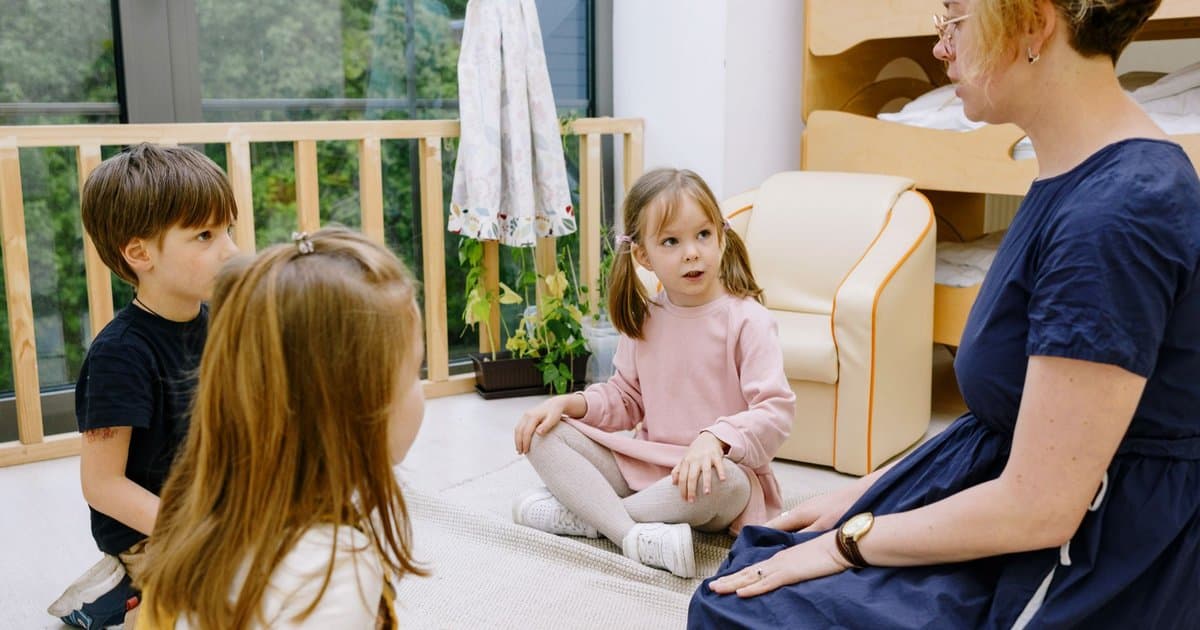
Your child screams every morning at drop-off. Your student freezes during every transition. You've tried explaining, bribing, even pleading, and nothing seems to stick. You're not failing. You're just missing a tool that matches how young children actually learn.
Social stories for preschool are short, simple narratives that walk children through situations before they happen. They describe what to expect, name the feelings involved, and show a positive path forward. Originally developed by Carol Gray in 1991 for children with autism, social stories are now widely used in general early childhood settings because they work with how preschool brains process information, through pictures, repetition, and concrete language.
This guide covers what social stories are, when to use them, how to write them, and how to make them part of your daily routine at home or in the classroom.
What Social Stories Are and Why Preschoolers Need Them
A social story is a brief narrative, usually 5 to 10 sentences, that describes a specific situation, the expected behavior, and what a child might feel along the way. Think of it as a rehearsal on paper.
Preschoolers (ages 3–5) are concrete thinkers. They struggle with abstract instructions like "be good at the dentist." But they can understand: "I will sit in a big chair. The dentist will count my teeth. I might feel nervous. That's okay. My mom will be right there."
Research supports this approach. A meta-analysis by Qi, Barton, Collier, Lin, and Montoya (2018) found that social stories produced meaningful behavior changes across multiple studies, particularly for young children. Visual and narrative-based teaching aligns with how preschoolers encode new information, they need to see it, hear it, and repeat it before they can do it.
Social stories work because they replace the unknown with something familiar.
When to Use Social Stories in Preschool
The most important rule: use social stories before the situation, not after. They're preparation tools, not punishments.
Social stories work best for predictable situations your child or students encounter regularly:
- Starting school or a new classroom
- Separation from parents at drop-off
- Potty training
- Doctor or dentist visits
- Getting a haircut
- Handling transitions between activities
- Managing big emotions like anger or frustration
- Welcoming a new sibling
Timing matters. Introduce the story one to two weeks before a new experience so children have time to absorb it through repeated readings. For daily routines like classroom transitions, make the story part of your morning circle time.
According to Gray and Garand (1993), social stories are most effective when they describe rather than direct, telling children what will happen rather than ordering them to behave a certain way.
How to Write an Effective Social Story for Preschoolers
Writing a good social story is simpler than you think. Follow this structure:
- Name the situation. "Tomorrow I go to the doctor."
- Describe what happens, step by step. "A nurse will measure how tall I am. The doctor will look in my ears."
- Name the feeling. "I might feel scared. That's okay."
- Include a comfort statement. "My dad will hold my hand."
- End positively. "After, we will go home and play."
Use first-person language ("I will…") and present tense. Keep sentences to 12–18 words. Include one simple illustration or photo per sentence, real photos of your actual classroom or doctor's office are even more effective than generic clip art.
Research by Kokina and Kern (2010) found that social stories with individualized details, the child's name, their specific environment, produced stronger outcomes than generic versions. The more real it feels, the more it helps.
Social Stories vs. Other Preschool Teaching Tools
Social stories aren't the only strategy, and understanding what each tool does helps you choose the right one.
Picture schedules answer "What's next?" They show the sequence of the day, circle time, snack, playground, but don't address feelings or teach skills. A child can follow a schedule and still melt down at transitions because they don't know how to handle the change.
Behavior charts reward compliance. They can reinforce positive choices, but they don't teach a child what to do or how to manage their emotions in the first place.
Social stories fill the gap. They answer "What will happen? How will I feel? What can I do?"
Many experienced preschool teachers use all three together: schedules show the flow, social stories prepare children for the hard parts, and charts reinforce what went well. According to the National Association for the Education of Young Children (NAEYC), effective early childhood practice layers multiple strategies based on individual children's needs.
How Often to Read Social Stories with Preschoolers
Repetition isn't overkill, it's the whole point. Young brains need multiple exposures to encode new learning. Research by Horst, Parsons, and Bryan (2011), published in Frontiers in Psychology, found that preschoolers who heard the same story repeatedly learned new words significantly better than those who heard different stories. The same principle applies to social learning.
Here's a practical reading schedule:
- One to two weeks before the event: Read the story once daily.
- The day of: Read it once or twice for reassurance.
- After the event: Revisit occasionally to reinforce what went well.
For classroom routines, keep laminated copies in a circle-time basket so children can "read" (look at the pictures) independently. This self-directed access builds confidence because the child controls when they revisit the story.
Don't worry about boring your child. When a preschooler asks to hear the same story again, that's learning in action.
Signs This Is Normal vs. When to Be Concerned
It's completely normal for preschoolers to:
- Need 6–10 readings before they seem to internalize a story
- Ask the same anxious questions repeatedly ("Will you pick me up?")
- Still show some nervousness even after preparation
- Regress temporarily during periods of stress or change
Most children settle by the third or fourth day of consistent story reading. Some children, especially those who are temperamentally cautious or highly sensitive, need more time. That's developmentally appropriate, not a red flag.
Talk to your pediatrician or an early childhood specialist if you notice:
- Intense fear or panic that doesn't decrease with preparation and repetition over several weeks
- Significant regression in skills they've already mastered (toileting, speech, eating)
- Persistent refusal to participate in routine daily activities
- Physical symptoms like stomachaches, headaches, or sleep disruption tied to anxiety
According to the American Academy of Pediatrics, anxiety that interferes with a child's daily functioning, not just occasional nervousness, warrants professional evaluation.
Real-World Social Stories for Preschool That Work
The best social stories are specific to your child and your situation. Here are templates you can adapt:
Starting preschool: "My school is called name. My teacher is name. I will hang my bag on my hook. I will play with friends. Mom/Dad will pick me up after snack."
Handling anger: "Sometimes I feel angry. Angry is okay. When I'm angry, I can take three deep breaths. I can squeeze my hands. I can use words: 'I don't like that.' My teacher will help me."
Getting a haircut: "I will sit in a special chair. The barber will use scissors near my ears. It won't hurt. I might hear buzzing. I can hold my stuffed animal."
Use photos from your actual classroom, bathroom, or doctor's office when possible. Kokina and Kern (2010) found that individualized, context-specific stories consistently outperformed generic ones.
How to Use Social Stories in a Preschool Classroom at Scale
Teachers managing 15–20 children can't write individual stories for every child, every situation. Here's a realistic approach:
Create 4–6 core classroom stories for the situations that affect everyone: transitions, cleanup time, sharing, using gentle hands, lunchroom behavior. Laminate them and rotate through one per week during morning meeting.
Use a simple template: "Child's name/We situation. What happens. What I/we do. How I/we might feel. Positive ending."
Personalize only when needed. Reserve individualized stories for children facing specific challenges, a new sibling, a medical procedure, or persistent behavioral struggles.
Train everyone on the same language. Share the story's key phrases with teaching assistants, specials teachers, and parents. When a child hears "I can take a deep breath" at school AND at home, the learning compounds.
Store stories where children can reach them. Accessibility is part of the strategy.
What to Do When a Child Resists or Calls It "Babyish"
Older preschoolers (ages 4–5) may push back on social stories, especially if they feel singled out. This is developmentally appropriate — they're asserting independence.
Try these adjustments:
- Rename it. Call it a "practice story," "learning book," or "my plan." Avoid language that feels clinical.
- Involve them. Let the child draw the illustrations or choose which details to include. Ownership increases buy-in.
- Add complexity. Older preschoolers can handle longer narratives with more detail and emotional nuance.
- Pair with role-play. Read about the dentist, then play dentist with stuffed animals, then go to the actual appointment. Multi-sensory practice reinforces the story's content.
Many parents find that making the child the "expert" — "Can you teach your stuffed bear about going to the dentist?" — reframes the story as something empowering rather than corrective.
Making Social Stories Stick: Personalization and Practice
Reading the story is step one. Making it stick requires active engagement.
After reading, ask open-ended questions: "What happens first at the doctor?" "How might you feel when Mom leaves?" "What can you do if you're scared?" These questions move learning from passive listening to active processing.
Role-play the scenario together. If the story is about drop-off, practice saying goodbye, waving from the window, and reuniting — at home, where it's safe.
Use consistent language. If the story says "I can take a deep breath," use that exact phrase in the real moment. Consistency bridges the story and real life.
Some parents and teachers find that personalized stories — where the child sees themselves as the main character, complete with their name, appearance, and familiar settings — deepen emotional connection and engagement, especially for anxious or resistant learners. This approach combines the evidence behind social stories with the power of seeing yourself succeed.
Your First Social Story: A Simple Action Plan
Start here:
- Pick one situation your child or class struggles with. Choose something low-stakes so you can learn the process without pressure.
- Write 5–8 sentences using the template: situation → what happens → feelings → coping strategy → positive ending.
- Add simple visuals. Photos, drawings, or even stick figures work.
- Read it daily for one week before the situation occurs.
- Observe and adjust. What landed? What confused them? Your second story will be stronger because you know your learner better.
Free templates are available through resources like the Gray Center for Social Learning and many early childhood education sites on Pinterest and Teachers Pay Teachers. Personalize whatever template you find — the research consistently shows that customization matters more than production quality.
Key Takeaways
- Social stories for preschool work because they match how young children learn: through pictures, repetition, and concrete language.
- Use them proactively — before the challenging situation, not as a consequence after.
- Keep stories short (5–10 sentences), use first-person language, and include feelings alongside expectations.
- Repeat the story daily for best results. Preschoolers need 6–10+ exposures to internalize new learning.
- Personalize with real names, real places, and real photos when possible.
- Layer social stories with picture schedules, role-play, and consistent language from all caregivers.
- Seek professional guidance if anxiety persists despite consistent preparation and significantly interferes with daily life.
Get practical parenting tips delivered weekly
Evidence-based guidance for the moments that matter. No spam, unsubscribe anytime.
Frequently Asked Questions
Keep reading
Supporting Siblings During NICU Stay: What Parents Need to Know
Help siblings cope with NICU stress through honest explanations, routines, and connection activities. Most behavioral changes resolve within weeks of discharge.
10 min read
Teaching Empathy Through Children's Stories: A Practical Guide
Learn how to teach empathy through children's stories with practical techniques. Research shows kids develop stronger peer relationships with regular diverse
10 min read

How to Motivate Students on Classroom Behavior (Strategies That Work)
Master 8 proven strategies to motivate students on classroom behavior. Learn why specific praise and consistency outperform rewards, plus tools that work.
9 min read
Get weekly parenting tips backed by research
Evidence-based guidance for the moments that matter. No spam, unsubscribe anytime.