Goodbye, My Best Friend
A story about dealing with loss, rewritten for your child
Every page is redrawn around the child you make it for. Keep the story’s own hero and give them your child’s name, or choose someone new — it takes a minute, and nothing is locked in.
From$34.99 USD
Free to start. No payment to see your child in the story.
- 32 pages, hardcover
- 5.9 × 5.9 in
- Ages 3-5
- Premium, thick pages
- Free standard shipping included
- Printed & delivered in 2-3 weeks (US)
Start with the story’s own hero or pick from our cast — then give them your child’s name.
A gentle, personalized story helping children ages 3–5 grieve the loss of their dog with love and hope.
That’s the story. The rest is how it becomes your child’s.
How personalization works
Who is this story about?

Keep the story’s own hero
The hero is already written and drawn for this book. Give them your child’s name if you like — that’s the whole edit.
Or swap in one of our cast
Eight characters to start from, and you rename whoever you pick.
- Luna

- Theo

- Mateo

- Sofia

- Amara

- Layla

- Mei

- Ravi

Or make your own
Describe them in a sentence, or add a photo to guide the likeness. Either way, entirely optional.
The characters are just the start.
Every part of this book is yours to change. Not a name dropped into a template — the whole thing is redrawn around the child you’re making it for.
- Every illustrationAll 32 pages are drawn fresh, not stamped with a face.
- The rooms and placesYour child's actual bedroom, your street, the places the story visits.
- The objects that recurThe specific blanket, the toy they won’t sleep without — carried page to page.
- Everyone else in itSiblings, grandparents, the dog. Named and drawn as themselves.
- The story itselfChange what happens, and the words on the page change with it.
- Or change nothingPick a hero and read it tonight. The rest is there when you want it.
What's Inside This Book
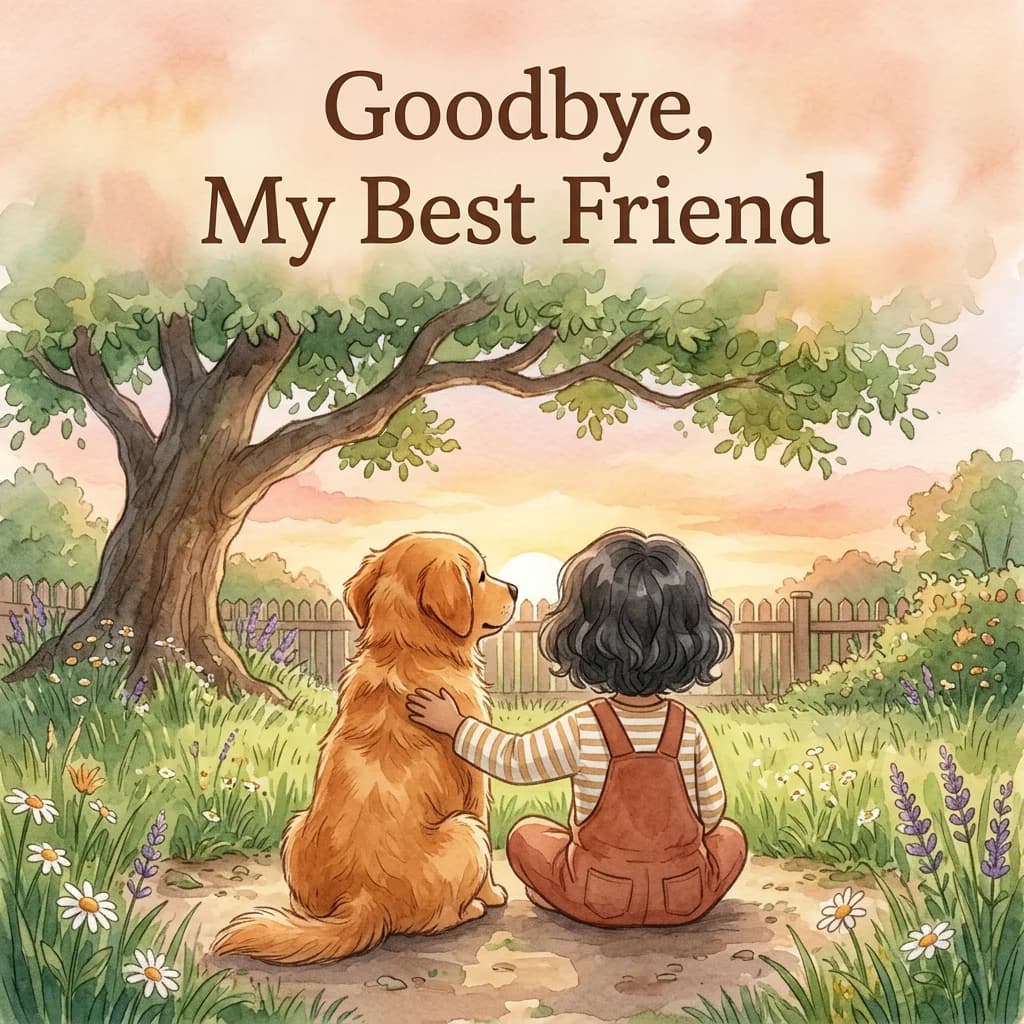
1 of 17 spreads
Every character, scene, and object in this book can be replaced with your own — your child's name, your family photos, your home, your school.
What you get
Free to start. No payment to see your child in the story.
Start free
- Free to start — no card needed
- See your child in the story in minutes
- Rename the hero and edit the story text
- Choose a ready-made character, or add a photo later
- Export a PDF of what you make
Your perfect keepsake
Hardcover book
- Full-color hardcover, 15×15cm
- Free standard shipping included
- Printed & delivered in about 2-3 weeks (US)
- Personalize names, story text & style
- Add your own photos once you are in the editor
Quick summary of Goodbye, My Best Friend
This personalized picture book helps children ages 3–5 understand and express grief after losing their dog. It validates tears, models healthy grieving through drawing and memory-keeping, and closes with hope — making it ideal for parents navigating a child's first experience of loss.
This personalized children's book guides children ages 3–5 through the loss of their beloved dog. Starring the child, their dog, and Mum, it validates grief, celebrates shared memories, and reassures little ones that love never truly disappears.
Key Takeaways
- Validates big grief feelings by naming them as proof of love, not weakness
- Models healthy coping through memory drawing, keepsake holding, and storytelling
- Strengthens parent-child bonds by placing Mum as a compassionate, present comfort figure
- Teaches that love outlasts loss — a foundational emotional literacy concept for ages 3–5
- Normalizes crying and sadness so children feel safe expressing difficult emotions openly
Why This Book Works
Naming grief as love in action is one of the most powerful tools in early childhood emotional literacy. Dr. Dan Siegel's "name it to tame it" framework shows that labelling emotions — "crying means you loved someone very much" — activates the prefrontal cortex, helping young children regulate overwhelming feelings. This story does exactly that on every page, transforming raw pain into something a child can understand and hold.
Personalization dramatically increases a child's engagement with emotionally difficult content. A 2020 study by Dr. Adriana Bus at Leiden University found that children who saw their own name and likeness in stories showed measurably deeper narrative comprehension and emotional connection. When the grieving child in this book is *your* child, beside *your* dog, the story stops being abstract — it becomes their own experience, witnessed and validated.
The book's closing imagery — butterflies, sunny mornings, a toy held close — aligns directly with evidence-based continuing bonds theory. Pioneered by Klass, Silverman, and Nickman (1996), this framework argues that maintaining a symbolic connection to a lost loved one supports healthy grief resolution in children, rather than hindering it. Rather than urging children to "move on," the story gently invites them to carry their pet forward.
Common Misconceptions
Children this age are too young to truly grieve a pet.
Research by Dr. Phyllis Silverman shows children as young as 3 experience genuine grief responses. Dismissing their loss can increase anxiety and complicate future emotional processing.
Reading about death will frighten or traumatize young children.
Child psychologist Dr. Alan Wolfelt notes that age-appropriate grief stories reduce fear by giving children language, context, and the reassurance that their feelings are normal and shared.
It's better to distract children from grief than to sit with it.
Avoidance prolongs grief. Dr. David Kessler's research shows that allowing children to acknowledge sadness — with support — leads to healthier long-term emotional regulation.
How to Read This Book with Your Child
Best time to read: Read within the first week after loss, ideally at a quiet moment — not immediately before bed if your child is acutely distressed.
Let your child hold their pet's favourite toy or a photo before you begin. Say simply: "This story is about missing someone we love. It's okay to feel sad as we read." Keep tissues nearby — your tears are permission for theirs.
Conversation Starters
- “What was your favourite thing you and [pet's name] did together?”
- “Where do you think [pet's name] is running free right now?”
- “What would you put in a memory box to remember them?”
Frequently Asked Questions
Is this book appropriate right after our pet has just died?
Yes — this book is designed for the immediate aftermath of pet loss. Reading it within the first few days provides children with language and emotional validation at exactly the moment they need it most. The closing message of hope is gentle, not dismissive of fresh grief.
My child keeps asking if the dog is coming back. Will this help?
It will. The story gently and clearly communicates that saying goodbye is permanent, without frightening language. Paired with a calm conversation, it helps children understand finality in a way that feels safe rather than scary.
What age is this book really suited to?
Ages 3–5, though it reads well up to age 7 for children who process grief slowly or revisit the story over time.
Can this book help if the child didn't see the pet die?
Absolutely. The story focuses on memory, love, and coping — not the mechanics of death — making it equally comforting whether your child was present at the end or not.
How do I read this without crying in front of my child?
You don't need to hide your tears. Child grief specialist Dr. Alan Wolfelt notes that seeing a parent cry actually reassures children that sadness is safe, normal, and shared — which is one of the most healing messages you can send.
A story about dealing with loss, rewritten for your child
Free to start. No payment to see your child in the story.
You Might Also Like
More Stories Like This
Building Inner Courage
How to Be Brave Personalized Children's Book
A gentle story about courage for little ones who feel wobbly inside.
Growth Through "Not Yet
The Magnificent Maybe: A Personalized Growth Mindset Book
A personalized story teaching kids that 'not yet' is the start of something great.
Setting Boundaries With Others
It's Okay to Say No – A Personalized How to Say No Book for Kids
Teach your child the power of 'no' through a story starring them. Builds body autonomy and confidence.
Standing Up to Bullies
Be Brave, Be Kind: Standing Up to a Bully
A personalized story that gives kids 5–7 the words and courage to stand up to bullying.